A Conference-Only Football Season … It’s Happened Before … in 1919
October 18, 2020 | Football
Feature
By Mike Pearson
FightingIllini.com
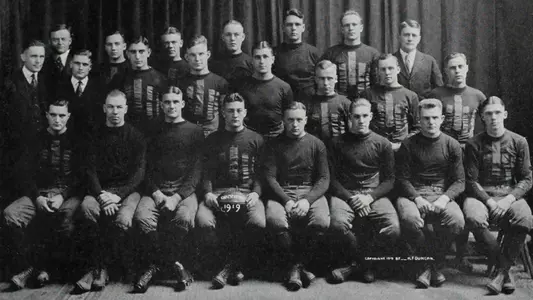
The University of Illinois football team's 2020 schedule is comprised entirely of Big Ten opponents. Today, we recall UI's 1919 season, the last time the Fighting Illini only played conference foes.
Though World War I was in the rearview mirror, American life in 1919 seemed anything but peaceful or secure.
The deadly Spanish Flu pandemic continued from the previous year with a third brutal wave in the Spring, bringing America's death toll to more than 600,000. A weeklong race riot in July on the south side of Chicago headlined more than 25 civil disturbances across the country. In September, thousands of steel workers went on what would ultimately become to be a four-month strike. And in early October, President Woodrow Wilson suffered a massive stroke, leaving him incapacitated for the rest of his term.
About the only positive news of 1919 was Congress's approval in June of the 19th Amendment to the Constitution, guaranteeing women the right to vote.
At the University of Illinois, bolstered by a number of returning war veterans, 3,134 students enrolled for Fall term classes under acting President David Kinley. On the north side of campus at legendary Illinois Field, Coach Bob Zuppke's seventh Fighting Illini football team prepared to defend its conference title.

Due to the return of talented veterans from overseas battle and the addition of several gifted newcomers, Zup was cautiously optimistic that this could be one of his most successful clubs. Among the 19 men who would eventually letter that season, 11 were returning veterans from the 1918 champs. Three others—Clarence Applegran, Lawrence "Otis" Petty, Edward "Dutch" Sternaman and Clarence Ems—had lettered for the Illini in previous years, but were engaged in military service in '18.
Still, it would be a bumpy road ahead, particularly because the schedule was comprised entirely of Western Conference (Big Ten) opponents.
The season opener was October 11 against Purdue at a muddy Stuart Field in Lafayette. UI's heftier Illini line, featuring center John Depler, guard Applegran and tackle Milt Olander, consistently opened holes for junior halfback Ralph Fletcher who scored twice in Illinois's 14-7 victory.
Game two saw Zuppke's troops host a talented Iowa squad the following week, a team that starred the fabulous Duke Slater and one that had blanked Nebraska in week one. An eager Illinois student body made up more than half of the 6,500 fans that turned out that day.
In unheard of double duty, former University of Chicago football star Walter Eckersall, who refereed the Illini-Hawkeye battle, also compiled the game story for the Chicago Tribune.
Wrote Eckersall in his lede, "Resurrection of the onside kick, one of the most dangerous plays in football, gave Illinois a victory over Iowa today on Illinois Field, 9 to 7, in one of the cleanest and hardest fought contests ever played on the historic gridiron."
"The play which apparently has been discarded by most coaches," Eckersall continued, "was called into action in the second period after Iowa had scored a touchdown in the first quarter. The ball at the time was on the Hawkeyes' 45-yard line. Illinois's (Albert) Mohr had been instructed to kick high. On a set signal, (Lawrence) Walquist, the Illini halfback, started for his goal. At the same instant Mohr signaled for the ball. As the kicker stepped forward and Walquist backward, the Illinois back was behind the oval when it was kicked. Quarterback (Bill) Kelly of Iowa permitted the ball to strike the ground and Walquist picked it up as it was bounding and ran over the goal line. The Hawkeyes made no efforts to stop him because they thought he was an offside player and that the ball would go to Iowa at the point where it was touched by Illinois."
The tables were surprisingly turned on Zup's Illini in game three when undefeated Wisconsin came from 10 points behind to win the game in the fourth quarter, 14-10. It would turn out to be the only time all year that Illinois would taste defeat.
Week four featured the long-awaited Homecoming showdown in Urbana against Amos Alonzo Stagg's powerful University of Chicago Maroons. Chicago hadn't been challenged in its first three games, outscoring Great Lakes, Purdue and Northwestern by a cumulative score of 180-0. Sixteen thousand fans packed the stands at Illinois Field and thrilled to the almost flawless play by their favorites. Ralph Fletcher, with brother Bob holding, gave Illinois a 3-0 lead with a 22-yard field goal in the second quarter, then scored a touchdown in the third period to provide UI with its final 10-0 margin.

The scene shifted to Minnesota's Northrop Field for game five and, for most of three quarters, the record crowd of 25,000 roared. After a Gopher touchdown midway through the third period gave the hosts a 6-0 lead, Zup's troops finally responded with a drive of their own. A 40-yard pass play from Walquist to sophomore receiver Chuck Carney started the flurry. Thirty-two more yards were gobbled up when Walquist connected with Bob Fletcher. The latter Illini's touchdown plunge and an important PAT from brother Ralph gave Illinois a 7-6 lead. Ralph added a 34-yard field goal in the fourth quarter, allowing the Illini to survive with a 10-6 victory.
Coach Fielding Yost's mighty Michigan Wolverines provided Illinois with its sixth test, traveling to Urbana for the first time in 14 years. However, on this particular November afternoon, the Illini totally outclassed the boys from Ann Arbor. Wrote one article, "If Zuppke had not been merciful and kept in his regulars, there is no telling what the score would have been." Onarga's "human battering ram" Jack Crangle, Springfield's Sternaman and Fulton lineman Burt Ingwersen were three of UI's biggest heroes in the 29-7 beat-down.
That victory set up a season-ending showdown in Columbus between the once-beaten Illini and unbeaten Ohio State. OSU ticket officials estimated that it could have sold in excess of 55,000 tickets, 40,000 more than the capacity of Ohio Field. Not only had the Buckeyes won every one of their six games, only one field goal had kept them from being perfect defensively. In succession, OSU had shut out Ohio Wesleyan (38-0), Cincinnati (46-0) and Kentucky (49-0), yielded but three points in a 10-point victory at Michigan, then blanked Purdue (20-0) and Wisconsin (3-0). What made matters worse for Illinois was that, due to injuries, Zuppke was minus four of his regulars.
Still, Buckeye coach John Wilce implored his team that victory would result only if it could mount a nearly perfect effort.
"We can win today," Wilce said, "but it will require every ounce of energy, fight and every bit of brainwork we can muster to turn the trick. No Ohio State team has ever faced a harder battle."
Illinois got on the scoreboard on its fourth offensive possession when Sternaman rambled 50 yards for a touchdown, lifting UI to a 6-0 halftime advantage. In the third period, Buckeye All-American "Chic" Harley countered with his own TD and PAT, giving OSU a 7-6 lead.
Trailing by a single point and with only two minutes remaining, Zuppke's club mounted one final drive from its own 20-yard line. He instructed his players to begin airing the football, consequently gaining chunks of 16, 24 and 14 yards. With the clock running and only seconds left, Zup desperately called on Bob Fletcher to sub-in for injured brother Ralph and attempt his first-ever field goal. The kick successfully sailed through from 30 yards and Illinois escaped with a 9-7 victory and the Big Ten championship. Days later, several media organizations awarded the Illini with the mythical national title.
Future College Football Hall of Famer Chuck Carney, Fletcher's close friend, recalled the postgame scene years later.
"I remember we went back to the athletic club where we were staying to wait to take the train back home," Carney said. "An alum walked up to Bobby and said he'd give him a sizable amount of money—as I recall it was over a thousand dollars—for the shoe he'd kicked the field goal with, but Bobby wouldn't sell it to him. I looked at the guy and said 'Hey, I'll sell you my whole suit for that much.'"
1919 Big Ten Football Standings
| Team | Record |
|---|---|
| ILLINOIS | 6-1 |
| Ohio State | 3-1 |
| Chicago | 4-2 |
| Minnesota | 3-2 |
| Wisconsin | 3-2 |
| Iowa | 2-2 |
| Northwestern | 1-4 |
| Michigan | 1-4 |
| Purdue | 0-3 |
| Indiana | 0-2 |