"And One of Them’s a Shadow, and One of Them is Grange”
September 5, 2019 | Football
The collegiate brand of football was born in the East—New Brunswick, New Jersey, to be exact—150 years ago this year when Rutgers and New Jersey (later know as Princeton) played before an assemblage of about 100 curious onlookers.
Not so surprisingly, Eastern teams dominated the sport in those early days, winning or sharing more than 90 percent of the first 50 consensus mythical national championships.
So, at the end of the 1924 season, Eastern sportswriters clamored for a match-up between the 1924 champion Penn Quakers and Bob Zuppke's '23 champion Fighting Illini. The celebrated Eastern sportswriters were anxious to see how the phenom from the Land of Lincoln—Illinois's Harold "'Red" Grange—would fare against "legitimate" competition.

Coach Louis Young's Quakers had rolled through their opponents in 1924, posting a 9-1-1 record, with seven of the victories coming by shutout. Illinois had been on a roll, too, claiming a shiny 14-1-1 record over its previous two seasons.
The contest was arranged by UI athletic director George Huff and Penn officials, with Illinois receiving 50 percent of the gate. Saturday, Halloween Day—Oct. 31, 1925—was chosen as the date for the clash at Philadelphia's venerable Franklin Field, a massive 60,000-seat stadium that had opened 30 years before.
According to business manager Everett Wells' report, the round trip expenses—including rail transportation, accommodations at Philadelphia's Manufacturers Country Club, meals, taxis and tips—were just more than $5,000 for the 34 UI players and an official party of six. The University's share of the game revenue would bear $67,129, so a sizable percentage of the profits were applied to the debt the Athletic Association had incurred from building Memorial Stadium.
Coach Louis Young's Quakers entered the contest with a 5-0 record, including impressive victories over Yale and Chicago, respective defending champs of the East and the Western Conference. With a bevy of talented players, led by All-America end George Thayer at end and back Jesse Douglass, Illinois's star running back would be hard-pressed to gain significant yardage.
The 1925 season began uncharacteristically poorly for an Illini team that had only known success in recent times. Other than seniors Grange and Earl Britton, Zuppke's starting 11 featured seven sophomores and two juniors.
"You can readily see that I have a very young team," Zup admitted.
Illinois dropped its season opener to a strong Nebraska team, 14-0, then snuck by Butler in game two (16-13). Narrow losses at Iowa (12-10) and at home to Michigan (3-0) left the Illini with a 1-3 record as they boarded the Illinois Central train bound for the city nearly 800 miles away.
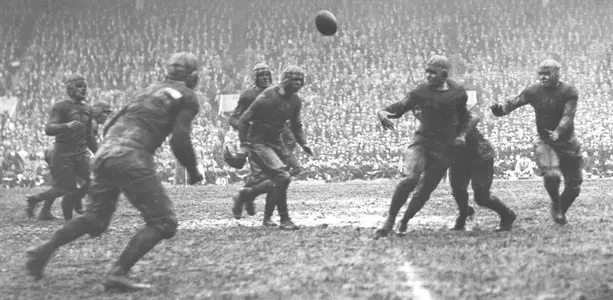
A cold autumn snow greeted the team as they arrived at Franklin Field on Saturday, muddying the playing surface inside. It hastened an Associated Press reporter to predict that the slow footing would greatly hamper Illinois's famed running back.
"On a wet field," he proclaimed, "I would say Grange is not to be feared."
Responded another, "Santa Claus himself would experience difficulty making ground over this neighborhood."
Referee Walter Eckersall called the captains to midfield for the coin toss, Joe Wilson for Penn and Grange for Illinois. The Illini would receive the ball first.
Penn kicked to Grange and No. 77 returned the ball to his own 36, but the drive stalled as the Quaker defense stiffened. Illinois's "D" was equally stingy and it got the ball back quickly. The pigskin was handed to Grange and he streaked through Penn's line for a 55-yard touchdown.
Wrote author Gary Andrew Poole in his 2008 book The Galloping Ghost: Red Grange, An American Football Legend, "The crowd was watching something that they could not quite comprehend. Grange seemed to be conquering nature itself."
On the next kickoff, Grange ran the ball back from his own 20 to Penn's 25-yard line, a 55-yard return. A Britton plunge into the end zone a few plays later made it 12-0 Illinois as the first quarter ended.
Midway through the second quarter, players on both teams were now totally covered in mud, making it impossible for fans to distinguish one from the other.
Penn was able to close the gap slightly in the second half when it blocked Britton's punt for a safety, but Illinois extended its lead to 18-2 late in the quarter on another Grange touchdown, this one on a 12-yard gallop.
The A.P. play-by-play report noted that Grange was, at this time, taken out of the game and replaced by Urbana's Ray Gallivan.

"The redhead, covered with mud from head to foot, was accorded a deafening ovation as he trotted to the sideline," the report said.
During the halftime intermission, Illinois players changed out of their mud-soaked uniforms and came onto the field for the third period "wearing clean suits and jerseys."
On its first series of the third quarter, Grange sparkled yet again, dashing from all directions. On a fake kick, Britton triggered a triple-pass play, first to Chuck Kassell, then to Grange who ran around right end for 20 yards and a third TD.
"(The play) made the spectators dizzy and the Penn players who were duped by it never knew what it was all about," said the Pittsburgh Press.
Afterwards, Zup gave the play a nickname. "I call that the Flea's Flicker," he said.
That touchdown would ultimately end the day's scoring, with the Illini prevailing, 24-2. The final stats showed Grange rushing the ball 28 times for 237 yards, catching two passes for 35 yards and a touchdown, returning a pair of punts for 12 yards, plus two kickoff returns for 79 yards.
The star-studded throng of reporters who'd assembled in the press box had a field day, reporting Grange's escapades in various verse and rhyme.
Damon Runyon, Universal Service: "This man Red Grange of Illinois is three or four men and a horse rolled into one for football purposes. He is Jack Dempsey, Babe Ruth, Al Jolson, Paavo Nurmi and Man o' War. Put them all together, they spell Grange."
Ford Frick, International News: "You may bait your trap for the stalwart bear … Or conquer the lion's might … But who can capture the rocket's flare … Or the will o' the wisp at night? … For the glimmer here, and a flicker there … And a gleam, like a rift of dawn … A sudden start, then a twist, a dart … And the will o' the wisp is gone!"
Grantland Rice, New York Tribune: "There are two shapes now moving … Two ghosts that drift and glide … And which of them to tackle … Each rival must decide … They shift with spectral swiftness … Across the swarded range … And one of them's a shadow … And one of them is Grange."