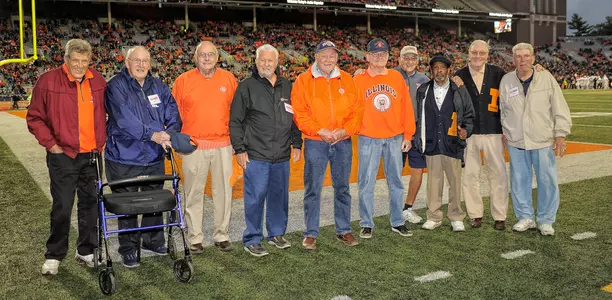
'A Time to Reflect on Memories' - 1953 Team Gathers for 65th Reunion
September 11, 2018 | Football, General, Varsity I
By Mike Pearson
FightingIllini.com
The Fighting Illini team that many historians call Coach Ray Eliot's greatest coaching achievement gathered last week to reminisce with their teammates from 65 years ago.
Sixteen members of the University of Illinois's 1953 Big Ten co-champions were special guests of the Varsity "I" Association at Memorial Stadium's Colonnades Club. Now in their mid 80s, each man had vivid memories of being a member of a team that was thought to have had little chance of winning the conference title.
Returning to the reunion were Herb Badal (Charlotte, N.C.), Dave Bauer (Benton), Jim Brosnan (Palos Park), Bob Des Enfants (Ames, Iowa), Gary Francis (Park Ridge), Leo Frazier (Chicago), Jack Henniff (Wild Rose, Wis.), Kenny Miller (Scottsdale, Ariz.), Jim Minor (Granite Bay, Calif.), Ralph Nelson (Ottawa), Peter Palmer (Shelbyville, Ky.), Bob Scott (Monticello), Jan Smid (Countryside), Cliff Waldbeser (Sun Lakes, Ariz.), Roger Wolf (Sugar Grove) and senior manager Charlie Finn (Champaign).
Deceased stars from '53 included J.C. Caroline, Mickey Bates, Rocky Ryan, Don Ernst, Em Lindbeck and Stan Wallace. And although those men's physical presence was missing, their contributions came up in numerous conversations throughout the night.
Illinois' 7-1-1 season came on the heels of a disappointing performance the year before. The 1952 team, a year removed from a Rose Bowl victory, lost five of its nine games and won only twice in seven Big Ten contests.
Finn said that the Illini coaching staff was resolved to begin the turnaround the spring before. Their optimism stemmed in great part from the addition of a pair of fleet-footed running backs named Caroline and Bates. As a tandem, they rushed for nearly 2,000 yards, including a Big Ten record 1,256 by Caroline.

Much of Illinois's offensive success was due to the efforts of its unheralded offensive line.
"We had a marvelous senior class," Finn said. "Our offensive line was especially talented. They were the key to opening the holes for J.C. and Mickey."
Jim Minor, the starting center on that line, gave high praise to fellow line mates Percy Oliver, Jan Smid, Don Ernst and Lenzini.
"Percy, Jan and Don were all very strong and very quick," Minor said. "But they were completely undersized as offensive linemen (Oliver weighed 194 pounds. Smid 196 and Ernst 186). Many times we'd double-team the opponent's best defensive linemen who were much bigger than us. As for Bob. He was a natural leader and should have received national recognition."
Following a 21-21 tie with Nebraska in the season opener and a 33-21 victory over eventual Pacific Coast Conference runner-up Stanford in game two, Illinois ventured to Columbus for a battle against highly favored Ohio State. The Friday before, Illinois' junior varsity squad played the Buckeyes' jayvee team. Stationed squarely on the sideline that day, eager to scout the Illini offense, was the entire OSU coaching staff, including head coach Woody Hayes.
"We didn't appreciate what they did, so we ran everything except our regular offensive schemes, actually making up plays from the single wing," Finn said.
On Saturday afternoon at The Horseshoe, Bates and Caroline exploded out of the gates, scoring three touchdowns in the first 14 minutes, including a 41-yard gallop by Bates and a 64-yard sprint to the end zone by Caroline. When the dust had settled at Ohio Stadium, the Illini's dynamic duo had combined for 339 yards rushing and scored all six UI touchdowns in a 41-20 victory.

Said Eliot afterwards, "It was one of those days when just about everything went right for us."
Herb Badal said that neither he nor his teammates were surprised to see what Bates and Caroline did that day to the Buckeyes.
"Ohio Stadium was the biggest and loudest stadium we'd ever been in, but it was a hush for most of that afternoon because of Mickey and J.C.," Badal said.
Illinois went on to post four more consecutive wins before being temporarily derailed by Wisconsin and its All-America running back, Alan Ameche, in Madison. UI concluded the season with a 39-14 victory at Northwestern, creating a tie for the Big Ten title with Michigan State.
In the 1976 book entitled "The Fighting Illini", Eliot told author Lon Eubanks that he was confident that Illinois would again represent the Big Ten in the Rose Bowl. Instead, in a narrow vote, conference athletic directors selected MSU.
"I've always looked with askance on that decision," Eliot told Eubanks. "It was a great disappointment, but I called Biggie Munn the night it was decided and wished him and his team well."
Officials from the Sugar Bowl attempted to seize the moment and invited Illinois to play in its New Year's Day bowl. However, Big Ten officials stood firm on its policy of only one team being allowed to play a post-season game and Illini players spent their holidays at home.
Minor remembered Eliot as a master motivator, recalling his pep talk prior to Illinois's 19-3 victory at Memorial Stadium over Michigan.
"He told us that he had gone over to the Michigan locker room to welcome the coaches and he spotted All-American Ron Kramer in the locker room," Minor said. "Ray told us, 'I saw that great player put his pants on one leg at a time, just like you boys.' He went on to say that he wouldn't trade his two ends for one or more Ron Kramer. That gave us all the confidence we needed."
A unique member of the '53 Illini was senior tackle and music major Peter Palmer from St. Louis. Before each home game, resplendent in his Illini uniform, he'd take the microphone and lead the crowd in singing the national anthem.

1953 Illini player Peter Palmer (third from left) had the lead role in Broadway's adaptation of "Li'l Abner"
"I came to Illinois known as a football player who could sing and left as a singer who could play football," Palmer said. "It was such a thrill for me to sing the anthem before the games. It ranks up there with anything I ever did."
After a stint in the U.S. Army, Palmer would go on to become a renowned Broadway star, winning the lead role as "Li'l' Abner" from 1956-58. He continued singing and acting in movies and television until 1994.
"I never retired," Palmer chuckled, "they just stopped calling."
Sixty-five years after having played their final game, the Illini players' love and admiration for their head coach has never ceased.
"Ray Eliot was a very inspiring individual and he was always for the little guy," said Badal. "He always told us 'It's not how big you are, it's how big your heart is.'"