Iowa Western Transfers Bring Winning Attitude To Illinois
September 10, 2014 | Football
By Lexi Shurilla, fightingillini.com staff writer | @SusanAlexisS
It's hard to argue with adding national champions to the Illinois roster. Whether it's at the high school or junior college level, the Illini have more than a few champs rounding out the football team. In fact, every quarterback on the roster won a high school state title. Receivers Martize Barr and Geronimo Allison both came to Illinois from Iowa Western Community College, a top junior college program and proven national champions. The pair still carries a natural note of confidence thanks to their winning ways as they are hopeful to get back to that point, this time in Orange and Blue.Playing at Iowa Western
Barr's college football career started out as planned. He was recruited to the University of New Mexico by former Illinois offensive coordinator, Mike Locksley, who took the head coaching job at New Mexico in 2008. Even at Illinois, Locksley was known for recruiting from the Washington, D.C. area - including wide receiver Arrelious Benn, 2007 Big Ten Freshman of the Year - and Barr was just the kind of talent he was looking for to add to his new roster.
"At New Mexico I really got the feel for Division I football," Barr said. "Feeling the crowds, playing at another location, our first game was at the University of Oregon, so that was big. It was important to get the game speed down as a freshman. I was 17 years old, so I really got the game speed down early. Then the ability to learn a complex offense, that really helped me at New Mexico."
After New Mexico struggled to get wins, Locksley was let go in 2011 and made the jump to Maryland. Barr didn't trust anyone else with his career, so he took Locksley's advice as he told him that the best fit would be at a junior college, so Barr made the switch to Iowa Western.
| Martize Barr hauls in a catch for a touchdown against Youngstown State. |
Once at Iowa, Barr had 31 receptions for 498 yards (16.1 ypc) and five touchdowns in 2012, helping lead Iowa Western to the NJCAA National Championship and a Midwest Football Conference (MFC) title with a perfect 11-0 record alongside current Illini Geronimo Allison and Dallas Hinkhouse.
"That was probably one of the best feelings and highlights in football that I've ever had," Barr said. "Winning a national championship was great. The one feeling I can remember is before the game, I looked into everybody's eyes and knew that they all wanted to win the national championship just as bad as I wanted to and that's a feeling I'll never let go. I can't wait to feel it again here."
After finishing at Western, Barr headed to Illinois, and it was time for a new receiver to take over in Iowa. Allison helped give Iowa Western another impressive season with an 11-1 record in 2013, including a win over No. 5 Butler in the Graphic Edge Bowl. Allison finished his career at Western with 69 catches for 872 yards and eight touchdowns, leading the Midwest Football Conference in all three categories, and his team finished 2013 ranked No. 2 in the NJCAA final national poll.
"It was great," Allison said about playing at Western. "I was a true freshman playing over there with a lot of the older guys and they really took me under their wings. They looked out for me and taught me a lot. Martize was always there for me. It was just fun being out there with them, as a freshman, winning game after game. We both know what it takes because we went through it. That's all we talk about is winning championships."
Transition Period
The recruiting process for junior college transfers starts with where are the positions in need. It may be a situation where there was one senior and the rest young kids, so Illinois has to try to bridge the gap. That gap can be caused by players getting older, injuries, guys leaving the program and just missing in recruiting sometimes. Once the coaching staff figures out where the gaps are, they're always looking a year or two ahead.
"First we look at the position then academics, they have to fit the academic profile here," Illinois' recruiting coordinator Alex Golesh said. "We're looking for guys that can be instant impact guys. When we say instant impact, starters or at least credible back-ups that can play, they've got to be at that level. The difference between a high school kid and a junior college kid is with a high school kid, you can look and project to develop guys, with a junior college guy, there's almost no developing in terms of instant development."
It's taken some time to figure it all out, but Golesh says they do target certain junior colleges from an academic pool. The California junior colleges academically fit the profile, Iowa Western fits the profile, there are some Northeast junior colleges that fit the profile and then occasionally you'll get a kid out of a Mississippi, or a Kansas junior college that the junior college may not necessarily fit the profile but the kid's academic structure does. By academic profile, that means classes that are comparable to what the classes at Illinois are.
When going from a junior college to a four-year school, especially an academic school like Illinois, the adjustment is tough from a rigor standpoint. But Illinois offers so much support academically that the transition is easy. Golesh says that he thinks Illinois has the best academic support in the country. Between its academic advisors and academic counselors, the support team works as hard as the coaches, doing whatever it takes to get the kids through school in an environment where they can be successful after college.
On the football side, Golesh says that if they're mid-year guys, meaning they enroll in January, it takes until the end of spring ball to figure everything out. If they're a May graduate, it generally takes them a year. By transferring early, they have six months in the strength program, whereas the May graduates have eight weeks in the strength program and then they're playing. Strength training is usually the biggest deficiency the players have coming into school. At many junior colleges, they don't have training or nutrition programs, so they didn't eat right and they didn't necessarily lift and train right because of the resources available to them.
| Geronimo Allison and Martize Barr Receiving Stats at Illinois | |||||||
|---|---|---|---|---|---|---|---|
| Name | Games | Rec | Yards | Avg | TD | Long | Avg/Game |
| Barr, Martize | 13 | 32 | 332 | 10.4 | 3 | 30 | 32.70 |
| Allison, Geronimo | 2 | 10 | 140 | 14.0 | 0 | 42 | 70.0 |
Allison said that at Iowa Western he didn't have the study halls and academic help Illinois offers, and in terms of facilities, there was one locker room, a practice field and they played their games at a high school.
Allison joined the Illini in January, and noted that spring and summer ball was a big eye opener for him getting used to the speed of Division I football. It's not just learning the culture of the program, but learning the playbook, the structure, adjusting to going to school and the other obligations from a community service standpoint, from a media standpoint and from whatever else they have going on. Golesh says the greatest improvement is usually seen in the second year, but Allison has already noticed an improvement in the short time he's been in Champaign.
"My game has changed a lot," Allison said. "From what the coaches tell me, to Martize. I see it in myself and in my body. I feel way different than how I felt in junior college. I feel smarter on the field and I feel like I'm moving better than I used to. It's good that I can see it, but it's also good that I have other's that see it too."
The Champs Are Here
Illinois had four seniors graduate at wide receiver last year, so in preparation for this season, they needed a couple players to bridge that gap. It started two years ago when Illinois knew it had seniors, so they signed Barr, knowing he would be a junior. Then this year, the same thing happened, and that's where Allison, Tyrin Stone-Davis and Raphael Barr came in, knowing that they needed to be starters or back-ups while the freshmen they recruited got older.
"I've recruited Iowa Western for five years since the program started," Golesh said. "I've kind of seen the program develop and I've seen the players develop. Those guys had a different attitude coming in. They knew what it was like to win. It's just like recruiting high school kids. You look for kids that have won. They add an instant leadership component for what you're trying to build. Those kids came in with an attitude that we win every game, and that's what we're trying to build here.
"When they come from programs like that, they've been coached the right way. You can't win a national championship or a state championship if you weren't coached in a manner to do so. Those kids have been coached, they've been coached hard. I know their position coaches well and they were coached the same way they're coaching them here. When we're on the kids hard to do it the right way, they've at least come from an environment where somebody has been hard on them and they've obviously handled it."
Barr originally had his sights set on the University of Maryland, but then he got an offer from Illinois and said what would be the next best place for a person from D.C. to go if you can't go to Maryland: Illinois.
"Dealing with Coach [Mike] Bellamy, he really sharpened down my route running and helped me with the little things that I needed to correct that I was just raw at in junior college," Barr said. "Now that I've got a D1 coach focusing on my skill set, it's really helped."
Allison was a year younger than Barr at Iowa Western, but when it came time to make the jump to Division I, Illinois coaches knew where they were looking.
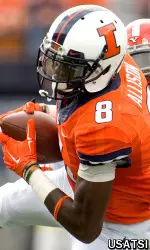
| In his first two games for the Fighting Illini, Geronimo Allison leads the team with 10 catches and 140 yards. |
"I came over here knowing somebody was here that I knew and that I played with," Allison said. "That just made me more comfortable with coming to Illinois instead of going to another school and being by myself. I had a friend over here, a brother over here. He was already in the rotation, so he was able to help me when I got here, with knowing the plays and knowing where I was supposed to be at this time, and just knowing the campus too."
"He was like a sponge," Barr said of Allison at Western. "He knew [we] came from Division I football, so he saw our work ethic and he just sat back and watched us. We told him everything we knew and then when he came here, I just saw how much better he had gotten over time and how he used what I gave him and put it all together. Now it's the same thing. I've been here a year, so I know how Coach Bellamy is and I know how Coach Cubit wants his stuff to be done, so I just help him out and there are little things that he helps me with too. We help each other now more than ever."
"We just compete," Allison said of his and Barr's relationship. "We push each other, we talk smack to each other. If he does something, I want to do it; if I do something, he wants to do it. It's like a big brotherhood between both of us."
Barr says he's much more confident now than he was last year in his game. He's more defined in his routes, he's quicker and he understands the offense a lot better. He says it's now or never now that he's a senior so he's focused on working hard, having fun and hopefully getting back to that champion status.
"That's what we're always telling them," Barr said of his teammates. "At receiver, we've got a couple guys that have won championships and we always say that no matter what level, you still won a championship, you still have that mindset to know what it takes to win a championship. So we all just sit back and talk about how we won, and what our teams did to win those championships. I think they definitely get that championship pedigree we give off."