Ryan McDonald - Engineering the Illini Offense
September 6, 2007 | Football
Sept. 6, 2007
by Kassie Barry, Illinois Sports Information
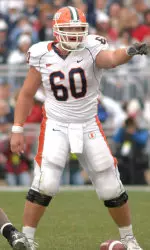
Balancing academics and athletics is never an easy job. However, it's a job that Ryan McDonald has taken in stride. McDonald, a native of Holland, Mich., has taken on a starting role as the center on the offensive line and is working toward a degree in the grueling field of engineering.
On the football field, McDonald is a leader. He anchored a rushing attack that finished first in the Big Ten and 10th in the nation last season. This year, McDonald is a candidate for the Rimington Award, which is presented annually to the nation's top center.
Offensive line assistant coach Eric Wolford described McDonald as a mature leader who plays a vital role on the offensive side of the ball.
"Ryan is our center, so he's the guy who makes all of the calls on the line," Wolford said. "He's a guy who has a lot of responsibility, both mentally, and obviously, physically. Ryan is very capable of playing any position. In his first year he played tackle, and last year he was our center. He's one of the guys we count on the make the right call and also to change calls when we need to."
"I think he's had a lot of academic success because academics are important to him," Wolford continued. "He's not just here to get an ordinary degree. Ryan is committed to it and he's got a bright future. When he gets out in the real world, it's going to be his game. I promise you that."
McDonald came to the University of Illinois to play football and be a part of the prestigious College of Engineering.
"All signs seemed to point to the University of Illinois," McDonald said. "The engineering program is awesome and both of my parents graduated from the University. My dad played football here in the '70s, and the football family and the atmosphere is perfect. I feel fortunate to be a part of it."
The College of Engineering at the University of Illinois ranks in the top five among approximately 300 engineering programs nationwide, according to U.S. News and World Report. The undergraduate engineering program ranked fourth in the 2007 America's Best Colleges edition of U.S. News and World Report.
 Junior center Ryan McDonald  |
|
The balance of academics and football has continued into the summer for McDonald. He knew he would be around this summer for football conditioning, so he looked into possible engineering projects that he could work on.
McDonald is one of 35 undergraduate students across the country participating in the Undergraduate Research Opportunities Program (UROP) this summer. UROP invites undergraduate students to be involved as junior colleagues of MIT faculty.
"UROP gives out grants to students across the country in the engineering field, with a majority of them going to University of Illinois students for undergraduate research," McDonald said.
"I went to Professor Ioannis Chasiotis, who I had two classes with, in January to see if he had any work that I could do for him this summer since I would be around for football," McDonald continued. "He then approached me with this project for NASA and Boeing."
The program was created in 1969, by the late Margaret L. A. MacVicar, Professor of Physical Science and Dean for Undergraduate Education. Edwin H. Land, the inventor of instant photography, provided the inspiration for the program. Land believed in the power of learning by doing. Undergraduate students involved with UROP have the opportunity to participate in each phase of standard research activity: developing research plans, writing proposals, conducting research, analyzing data and presenting research results.
When he wasn't in the weight room, Ryan was in the engineering lab. His time in the lab was spent making and testing the strength of fibers.
"What I'm doing in the lab is making nanofibers," McDonald said. "I do this through a process called electrospinning. Electro-spinning is where you basically dissolve the polymer, which is what fibers come from, in a solution that you put into a syringe with a needle on it and you apply a high-voltage current to the needle and it shoots the solution out and creates tiny fibers onto a collector.
"The goal of the research is to test the strength of the fibers once they are collected. My professor had his graduate students design a micro-electrical mechanics device, which is about the size of a quarter, that will pull the fiber to test how strong it is."
McDonald explained that the fibers he is making are used in composite materials that are found in the skin of a rocket or an airplane. The fibers also can be found on a car or in the graphite shaft of a golf club.
Chasiotis, a professor in aerospace engineering, had nothing but high praise for the work that McDonald has done in the lab.
"Ryan took over a challenging nanotechnology-related summer research project," Chasiotis said. "He single-handedly developed an apparatus to synthesize polymeric nanofibers with diameters smaller than one hundredth of a human hair.
"Ryan worked very methodically to identify the optimal fabrication parameters for desired nanofiber diameters and properties. Such nanofibers will be integrated in emerging applications in aerospace engineering," Chasiotis added.
McDonald is no stranger to academic success. He has been named the team's scholar-athlete award twice, most recently in 2006. Last season, McDonald earned CoSIDA/ESPN The Magazine All-District honors. He also earned Academic All-Big Ten honors the past two years. With careful preparation, McDonald has been able to balance life on the field and in the classroom.
"I've been fortunate enough to have a balanced class schedule each semester and then a class or two during the summer, McDonald said. "In the engineering field, 13 to 14 is a lot of work, but it's do-able and it's been going well so far."
Football academic advisor Kristin Kane commended McDonald on his academic achievements this summer.
"I was really excited that Ryan had an opportunity to do some hands-on work in the aerospace engineering field this summer," Kane said. "The internship was something that he pursued on his own throughout the course of the spring semester to get set up for the summer.
"Not only was he able to earn credit hours for his work to get him closer to graduation, but he also gained some invaluable knowledge that will help him as he pursues his career when he is done with school."
Kane added, "these types of laboratory research experiences are crucial for students in the sciences, and Ryan was able to gain this without missing a beat with football. Ryan is a stellar example of what is possible for our student-athletes if they take advantage of the resources available on our campus."
McDonald is already looking to the future.
"I'm looking into getting my master's degree since I will have a fifth year, and hopefully the research experience I gained this summer will help me with that. Down the road, I hope to get a job with a large firm such as NASA or Boeing working on making planes."