Illinois’s African American Pioneers
February 1, 2021 | General, Diversity, Equity & Inclusion
Feature
By Mike Pearson
FightingIllini.com
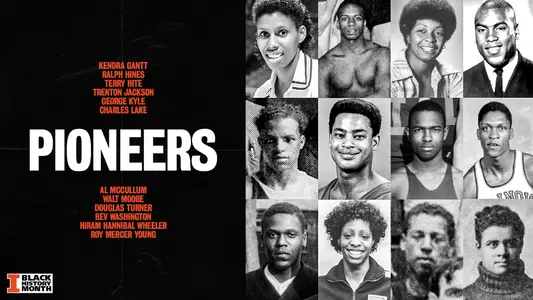
It's important that Fighting Illini fans know the names of Hiram Hannibal Wheeler and Roy Mercer Young. They are two men who were instrumental in changing the course of intercollegiate athletics at the University of Illinois.
In 1904, more than a century ago, Wheeler and Young broke the color barrier at the Urbana-Champaign campus, integrating varsity rosters that had previously only included white men. They came on the scene at Illinois about 14 years after the first known African American collegiate football players—W.T.S. Jackson and W.H. Lewis—arrived at Amherst College in Massachusetts.
Wheeler and Young are but two of the pioneering black athletes who altered the face of the program's African American make-up.
Wheeler, born Nov. 30, 1881 in Chicago, participated in both football and track and field as a student-athlete at Illinois. He lettered in as a sprinter for rookie coach Harry Gill in 1904. In a dual meet with Purdue on May 13, 1904, Wheeler became the first African American to win a track event by winning the 100-yard dash (:10.6). A resident of Urbana after attending university as an agriculture major, Wheeler was employed by his alma mater as a clerk in the UI's agriculture department. During World War I, he was training in New York as an Army soldier. In early October of 1918, Wheeler was home in Urbana with his wife and four children on a three-week furlough and was scheduled to depart for France in the capacity as an Army secretary. Unfortunately, he was a victim of the Spanish influenza pandemic and died at his home on West Clark Street just shy of his 37th birthday. He is buried at Champaign's Woodlawn Cemetery.
Young, who was born on April 27, 1887 in Springfield, lettered twice as a tackle for the Illini football team. His 1904 squad compiled an impressive 9-2-1 record and registered a 5-4 mark the following season. Described as extremely intelligent and articulate, Young attended Northwestern University's Dental School and served as a dental surgeon during World War I in the U.S. Army. Dr. Young also became a minister in Evanston. Like Wheeler, Young died tragically. His 1946 obituary indicated that he was struck as a pedestrian by an automobile in Gary, Ind. and died from multiple injuries at the age of 59.
A third African American Illini, George Kyle, competed as a non-letter-winning sprinter in track and field on the 1924 and '25 teams. Kyle was the first black athlete to acquire his bachelor's degree (Liberal Arts and Sciences in 1926), then a master's degree (psychology in 1930).
In tennis, during the late 1920s, a man named Douglas Turner became the first African American to play the sport at Illinois. Turner took second place in 1930 Western Conference (Big Ten) singles competition, then a few weeks later won the national championship among black men at the American Tennis Association tournament. Turner earned both bachelor's (1931) and master's degrees (1934) at Illinois. He served three years in the Navy during World War II. Turner died in Chicago at age 85. It wasn't until two decades later that another African American athlete lettered in tennis. Albert Grange, a transfer student from George Williams College, won a varsity monogram in 1951.
Wheeler, Young, Kyle and Turner were the only four African American athletes who competed at Illinois between 1900 and 1929.
A gentleman named Ralph Hines swam but did not letter for Coach Ed Manley in 1947. Hines also competed briefly on the track team as a junior in 1948, the same year he served as President of UI's junior class. After acquiring his BS in physical education (1949) and master's in sociology (1952) from the U of I, Hines secured a PhD in anthropology and sociology from the University of Coppenhagen in Denmark (1955). After teaching at Langston University, Alabama State, Tennessee State, Austin Peay and Meharry Medical College, he was named executive vice president at Meharry in 1968. Hines died in 1999 at the age of 72.
While Mannie Jackson and Govoner Vaughn are most widely recognized as Illini men's basketball's African American pioneers in the late 1950s, it was Walt Moore who initially integrated Illinois hoops in 1951. Moore had teamed with fellow Illini Max Hooper at Mt. Vernon High school and was recruited to Champaign-Urbana by UI coach Harry Combes. Moore's Illini career, interrupted by three years of service in the United State Army, lasted only one year, as a freshman in 1951-52. He eventually became the head coach at Western Illinois University, the school where he earned small college All-America honors in 1956. Moore died in 2004 at age 71.
Though he didn't letter, the color barrier in fencing at the University of Illinois was initially broken by Richard Younge in 1948. The World War II veteran received his BS in 1949. John Cameron competed in sabre for Coach Maxwell Garret and lettered for Illinois's undefeated teams and Big Ten champions in 1952 and '53. Cameron captured the conference title in sabre in 1953 and became UI varsity athletics' first African American captain. A 1960s black fencer, Craig Bell, won Big Ten and NCAA fencing championships in 1965.
The first black man in Illinois's wrestling room was in the mid 1960s when Al McCullum joined Coach Buell "Pat" Patterson's squad. Wrestling at 130 pounds, McCullum, who hailed from Joliet, lettered from 1964 through '66. He received his bachelor's degree in chemical engineering in 1967.
It wasn't until 1965 that a black man played baseball at Illinois. Trenton Jackson, from Rochester, N.Y., had already made an impact with the Illini football team—lettering in 1962 and '65—and UI's track and field squad (1963, '64 and '65). He was park of UI's NCAA-winning 440-yard relay team and also won Big Ten titles in the 100 and 220. Jackson finished eighth in the 100 maters at the 1964 Summer Olympics in Tokyo. Jackson hit .235 in the only season he played for Coach Lee Eilbracht's baseball squad. He received his BS in physical education in 1966.
In the sport of gymnastics, former Illini star Charles Lakes accomplished firsts more than once. Not only was he Coach Yoshi Hayasaki's first African American athlete, lettering from 1983-85, Lakes departed the U of I in 1986 to become one of the first black American gymnasts to compete in the Olympics. He won six Big Ten titles at Illinois and won the 1984 NCAA high bar championship.
Will Clopton, who played in the mid-late 1980s, is believed to be the first African American to be a member of Illinois's golf team.
When women's varsity athletics debuted at the University of Illinois in 1974-75, black female athletes were present, though sparse in numbers. Some of the most prominent in the early days of Illini women's athletics were track and field's Bev Washington and basketball's Kendra Gantt. Terry Hite, who directed UI's volleyball program from 1975-77, was the university's first black head coach. In 2021, about 30 per cent of the athletes comprising UI women's 10 varsity programs are of African American decent.