Selfless Staff a Silver Lining Within Pandemic
October 11, 2020 | General
Feature
By Mike Pearson
FightingIllini.com
When the going gets tough, the tough get going.
When COVID-19 first impacted America's collective conscience last March, little was known about how it would come to affect the future of intercollegiate athletics, its student-athletes, and the dedicated men and women who directly support it. Financially, it decimated the athletic department budgets, causing athletic directors to ponder seismic changes.
Illinois was no different with early projections of anywhere from $20-40 million in losses just for the 2020-21 season. The challenges ahead were going to require tough decisions, sacrifice and selflessness from an Athletics staff of more than 300.
Many in the industry have suffered furloughs and massive layoffs. In searching for ways to offset financial losses, one suggestion from Illini administrators was a strictly voluntary salary reduction for staff members who made $80,000 or more. Whitman admits that it wasn't an easy request.
"Everybody says the right things until you start asking people for money," he said. "All of a sudden, in this environment, everybody really stepped forward. Our message was that if we can share this challenge relatively evenly across a certain subset of our group, then no one person has to bear an inordinate portion of that. That really seemed to resonate with people."
What resulted was a $2 million savings, exceeding the original target of $1.8 million.
"Because the 87 individuals did what they did, we were able to avoid touching roughly 200 of our staff members whose salaries would have made it a burden to participate," Whitman said.
However, that was just the beginning of the selfless sacrifice that has taken place over the past six months.
Nearly every Illini athletics staffer has contributed in other ways.
It is no secret that the University of Illinois has undertaken ambitious testing and contract tracing protocols in order to maintain a robust campus experience for the 50,000-plus student body. When bodies were needed to develop and execute the plans, Athletics was the first in line to assist.
In July, interim director of the State Farm Center John Marquardt was asked by UI's Student Affairs to transition to a leadership role with the university's COVID testing operation.
"When COVID hit in March, everything we did at the State Farm Center came to a screeching halt," he said.
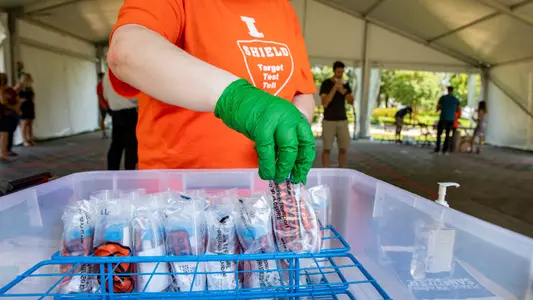
He now helps to oversee the 17 sites across campus and the 450 staff members (including 40 DIA colleagues) who are involved with administering the undertaking. Of the 17 sites, the SFC's West Grand Lobby is the largest. Approximately 10,000 individuals per day, more than 60,000 per week, go through the testing process. Students are required to test twice weekly, while UI faculty and staff are asked to do so once a week.

"The student walks in the door and immediately gets checked in," Marquardt explained. "Then, directed by another staff member, he proceeds to another station to submit a sample in a plastic tube. They then deposit their tube into a bin at the check-out station, then they're on their way. All of this happens within a matter of two minutes or less. The testing operation has been the one thing that's allowed our campus to re-open."
Other DIA staff members, including Assistant A.D. for Event Management Zach Acton, have stepped out of their typical roles to contribute to UI's overall campus effort. Because of Acton's expertise in coordinating large-scale events, such as Illini football and basketball games, he was recruited by university officials to help oversee and schedule DIA staffers who are in supervisory roles with the campus's Wellness Support Associates (WSA). This group ensures those who are entering campus buildings have been tested and are cleared for access.

"Our backgrounds in helping to run large-scale events definitely helped campus officials answer some of their logistical questions," Acton said. "Those of us who work in athletics are used to moving quickly, adjusting on a dime and doing it all knowing a positive experience is vital. It has been very applicable to our current campus climate."
And while Whitman is immensely proud of the sacrifices and efforts that his staff members have made for the betterment of campus, it was equally important to take care of Illini student-athletes.
The pandemic has drastically changed the roles that the Illinois sports medicine and nutrition staff have taken on.
Director of Sports Nutrition Brittany Perry now has the massive responsibility of feeding more than 500 varsity athletes in dramatically different ways, due to state-imposed social distancing.
 |
When Illini athletes began returning to Champaign-Urbana in June to begin their training regimen, she had to make sure that they were getting three well-balanced, nutritious meals per day, plus hydration, supplements, and snacks.
With the valuable assistance of local caterer Dish Passionate Cuisine, directed by head chef Colleen Hatton, Perry and her nutrition staff took daily delivery of anywhere from 100 to 300 meal bags, which they stored overnight at the Varsity Room's walk-in refrigerator. Athletes who were not isolated in quarantine came to the south end of Memorial Stadium to pick up their meals, but for athletes that were isolated in local hotels and apartments, delivery of the individual meals traveled to them.
"Josh and his executive staff began to realize how much of a burden this was for our staff, so he encouraged people in the athletic department to volunteer and help us out," Perry said. "These people included a wide variety of coaches and many other staff members. We'd give them the addresses they needed to be delivered to and off they went. Really, the entire athletic department has pitched in with this."

Staff members are also serving as door attendants at four major facilities to take wellness vitals – temperature and pulse ox – for everyone entering the building, freeing up athletic trainers to concentrate on caring for the student-athletes.
There isn't one faction of the department that hasn't been forced to adapt and redefine their value to the DIA. Whitman is convinced that several "silver linings" have revealed themselves during this challenging period.
"There is a certain mentality with individuals that are involved in intercollegiate athletics," Whitman said. "It's (a profession) that requires so many hours—including a lot of time in the evenings and weekends—and something that has so many emotional ups and downs because of the very public nature of what we do. Difficult circumstances draw folks close and it forms a unique bond unlike anything I've seen in other elements of business or society.
"In a strange way, though we're not actually together, it's helped to build trust within the department," he said. "Perhaps this will push us to recalibrate a bit and really lean ourselves out in a healthy and productive way. We've really had to differentiate between what's a true need and what's a want."
And when the Illini football team kicks off against Wisconsin on Oct. 24th, Whitman says it will be a particularly special day for him.
"It will certainly be an emotional experience for me, just knowing all of the sacrifices and all of the efforts from all of the different people who have gone into making that moment possible. Certainly, what's happened over the last seven months isn't something that we ever would have wished for, but as anything else I think you have to find the good in the face of the bad. I feel like our people here—those student-athletes and staff members—have stepped up and done that."