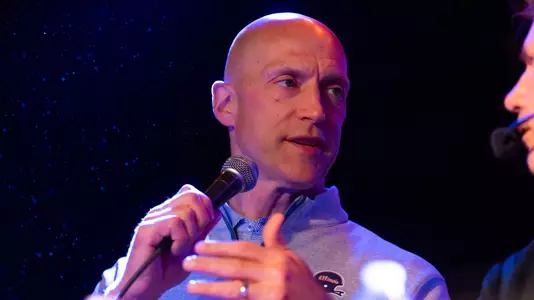
Josh Whitman: 10 Years of Reflection, Observation, and Anticipation
February 17, 2026 | General
A Letter From the AD
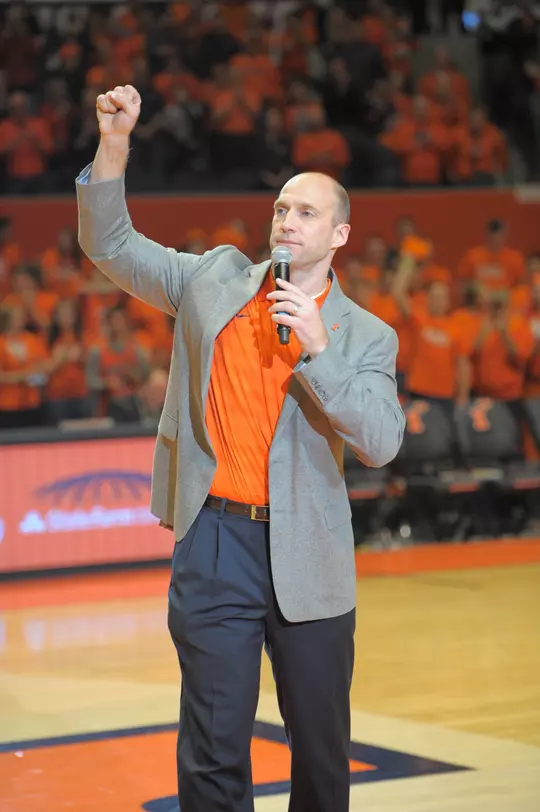
Today marks ten years to the day from when I was announced as your director of athletics – a long time in a role like this one. Being an athletic director is like riding a bucking horse; over the years, I have watched many of my friends and colleagues depart – talented, experienced, big-hearted professionals. Thus, I have gone from being the youngest athletic director in the autonomy conferences to one of the most senior, all in the span of a decade. I feel fortunate to still be riding the horse.
Much has happened in the last decade. A global pandemic. Political upheaval. Economic uncertainty. Social unrest. War. The world feels edgier, unsettled. People are more polarized in their beliefs and, increasingly, more disrespectful in their discourse. Fueled by distrust, emboldened by the relative anonymity of social media and the spontaneous convenience of cell phones, and gaslighted by the faceless algorithms that normalize our worst impulses, it is as if millions of people the world over are silently shouting at each other, creating a collective conscience that lacks empathy, nuance, or compromise. We have all been relegated to an oversimplified, binary existence, where people, events, and beliefs are right or wrong, good or bad, with us or against us. Amidst all this obfuscation, the truth has never been harder to find. Even higher education, which traditionally has been a vehicle driving toward truth, finds itself in the crosshairs, with criticisms inbound from all sides of the political spectrum, questioning its ideology, its value, or both.
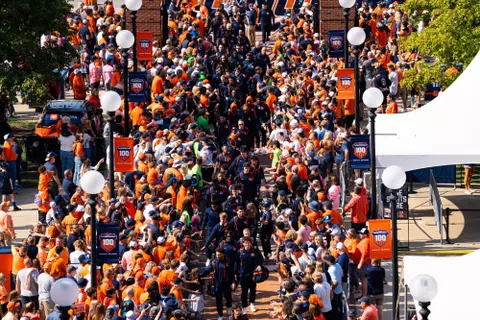
Against this chaotic backdrop, college athletics has never been more important. The intense tribalism that accompanies college sports amplifies the feelings we are experiencing in society more broadly (“with us/against us!” “we’re the best/you’re the worst!”). But at a time when the world is trying to pull us apart, college sports endeavors to hold us together. For four hours every fall Saturday and in gymnasiums and tracks and swimming pools and courts and fields and ball diamonds across the country, thousands of people from all walks of life come together to support their school. And in that shared experience, there is magic. Barriers lowered. Friendships forged. Memories made. An authentic moment derived not from a screen but from genuine community and unscripted emotion.
Some will argue that college sports cannot be the unifying force I envision because our system is every bit as broken as the world in which it exists. I admit that the college athletics of today is the barely recognizable descendant of the system that benefitted me as a student-athlete in the late 1990s and that was still largely in place when I stepped into this role in 2016. But I disagree with those who characterize college athletics as “broken.” The system is evolving at a breakneck pace, and the changes we are experiencing are profound – and, in many cases, overdue. My job, not to mention the jobs of our coaches, is a mere shadow of what it was only ten years ago. But just because something makes us uncomfortable or forces us to think and act differently does not make it wrong.
Too often we want change to occur as we read about it in the history books, boiled down to a few orderly paragraphs that tell a cleanly summarized story. But that is not real life. Big change is messy – and like when you organize your closet at home, pulling everything out before putting it back differently, sometimes things need to get messier before they regain order. Rather than complain about where we stand, let’s appreciate the moment we are in – which, make no mistake, is history in the making – and work together to make it the best story imaginable.
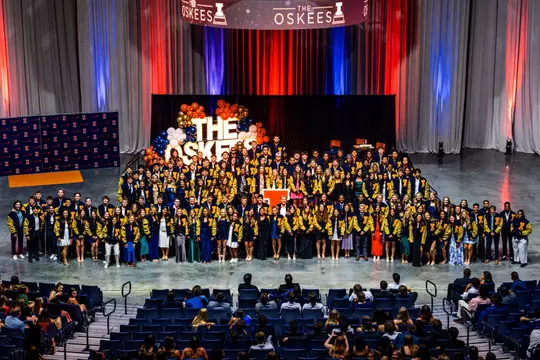
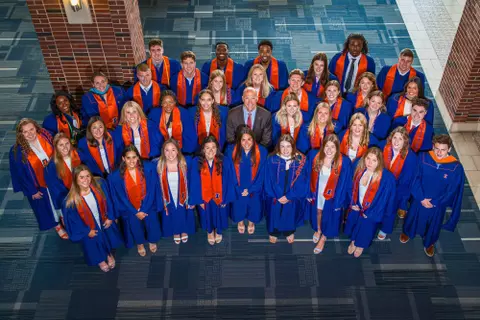
To our most important stakeholders – the student-athletes – life in our athletics program has never been better. Today, every Fighting Illini student-athlete receives a full scholarship, including a cost-of-attendance stipend, to obtain a world-class education at the University of Illinois. Support is offered in abundance, in the form of first-class physical and mental health services, personal and professional skills development, leadership training, and food and nutrition counseling. At Illinois, one in three student-athletes has a revenue share agreement with the University, ranging in compensation from several thousand dollars to over $1 million, with more than $20 million now moving annually from the University to our student-athletes’ pockets. In addition, student-athletes have the opportunity to earn money in exchange for commercial use of their NIL, which has been highly lucrative for some and a fun side hustle for others. Student-athletes are also enjoying greater mobility, with an opportunity to transfer that mirrors that of their non-athlete peers. This alleviates pressure on a student-athlete’s initial college decision and allows them to continue looking for the institution that offers them their desired mix of academic rigor and athletic opportunity.
And make no mistake: Illinois is thriving amidst the disruption. I leave it to others to narrate the growth our program has experienced over these last ten years – competitively, financially, reputationally. In my opening letter to you, released on this same date ten years ago, I outlined our objectives: “First, we will prepare our student-athletes, as graduates of our institution, to be leaders in our changing world. Second, we will build a prouder, stronger, and more passionate constituency of alumni, donors, and fans. And last, but certainly not least, WE WILL WIN.” I am proud to report that this athletics program has delivered on each of these three promises.

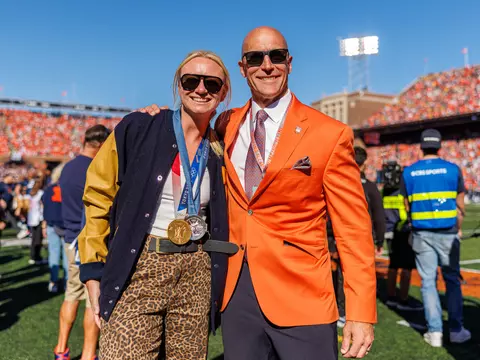
I can’t help but reflect back to the early spring of 2018. On the last day of February, our men’s basketball team, playing in Madison Square Garden, lost to Iowa in the opening round of the Big Ten Tournament, finishing the season with an overall record of 14-18, 4-14 in the Big Ten. That same day, our women’s team lost in Indianapolis in the Big Ten Tournament to Penn State, concluding the season with only nine total wins, including an 0-16 record in the Big Ten. Both basketball teams’ seasons were over in February. And this was on the heels of a football season, in 2017, when we finished winless in the Big Ten, with only two total wins, both against Group of 5 opponents. The days were dark.
The next day, on March 1, 2018, while on the bus to the airport outside New York, I was a bundle of raw emotion. Embarrassed. Angry. Disappointed. But never discouraged. Never wavering. Committed. Proud. Motivated. Defiant, even. So I did something I rarely do: rather than channeling my emotion inward, which is my custom, I went to Twitter. And I sent a series of tweets from the bus that culminated with this: “We are writing one of the great stories in the history of college sports, and the ending is even better than you can imagine. Thanks to ALL for your efforts and support to help us make it happen. I am one proud #ILLINI. Orange and Blue Forever. #WeWillWin.” Fast forward to February 2026. We are far from any ending to the story we are writing, but I hope you agree that it is becoming a real page-turner.
We are writing one of the great stories in the history of college sports, and the ending is even better than you can imagine. Thanks to ALL for your efforts and support to help us make it happen. I am one proud #ILLINI. ???? forever. #WeWillWin
— Josh Whitman (@IlliniAD) March 1, 2018
In my opening letter from 2016, I said the following: “We need a fully involved Illini Nation. A mass of people so overwhelming in size, passion, and influence that nothing will deter it from achieving its objectives. We need you – all of you, from the most avid to the most apathetic. The larger our coalition grows, the stronger our chances for success become.”
Ten years later, I am awestruck by your response. To the famILLy, I offer a sincere, heartfelt thank you. To our donors, many who have become close friends, thank you for opening your homes and your hearts, sharing your stories and experiences, and investing in our vision for this program. You have stepped forward early and often, sometimes with little notice and even less clarity. Your engagement adds purpose and momentum, and your friendship and support have changed Illinois Athletics. I am humbled by your trust and confidence. We are just getting started!
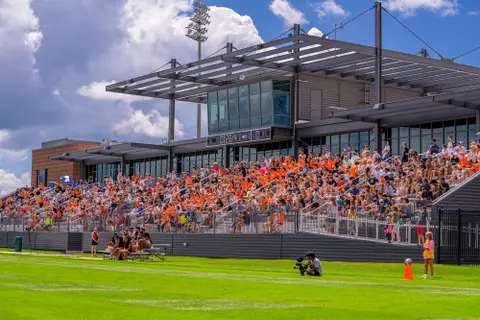
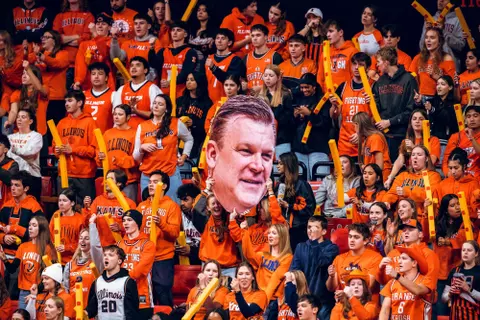
To our fans, thank you for answering the bell time and again. Not long ago, tickets to an Illini game were not hard to find. Today, thanks to your passion and presence, our crowds are among the best we have ever seen. Seeing firsthand the power of our famILLy has been breathtaking. Your energy and enthusiasm have lifted this program out of an extended slumber, and our future is even brighter than we can imagine.
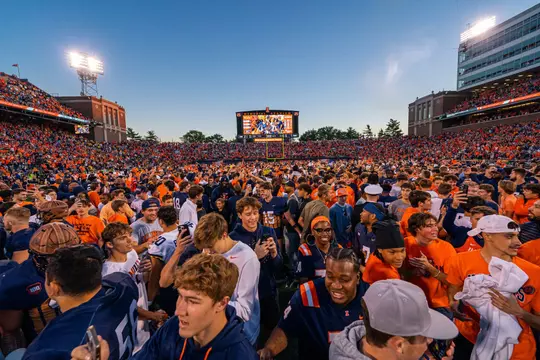
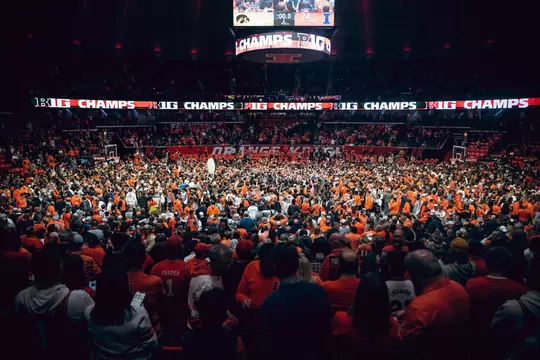
Speaking of the future, our new challenge is never to fall prey to complacency. The minute we believe we have arrived is the minute we will be passed by our peers. We cannot change the mentality that brought us here. We are underdogs. We are fighters. We approach each day with a Chicago-sized chip on our shoulder. We must continue to view disruption as our friend; chaos creates opportunity. Bold strategy matched with shared commitment and gritty execution will yield extraordinary results. As good as it has been to be an Illini these last several years, we can be even better.
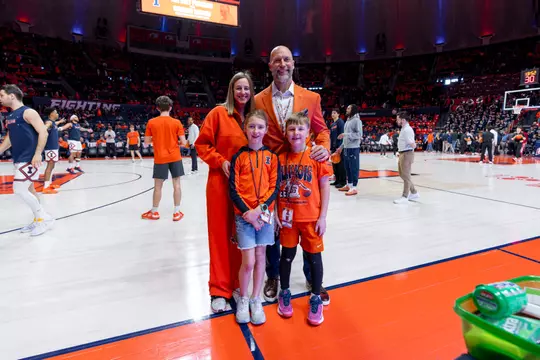
For Hope, me, and our children, the last ten years have passed in the blink of an eye. Thank you for welcoming us home and changing our lives. We are indebted to you and to this place, and we are honored to be part of this University and this community. The best is yet to come!
With deep respect and heartfelt appreciation –
Josh Whitman