Catching Up With Bobby Mitchell
May 11, 2007 | Football
May 11, 2007
Editor's note:
It has been nearly 50 years ago that Bobby Mitchell left the Illinois campus to embark on his professional football career. At the time, the Fighting Illini speedster had no idea that he would spend more than 40 years of his life immersed in the game he learned to love. Recently we had the opportunity to visit with the all-star gridder and track star as he reflected on his storied career.
It was one of those situations where you don't get your way, but later you're glad you didn't.
Bobby Mitchell wanted to go to Grambling University and play for the legendary coach, Eddie Robinson. Instead he found himself on a train headed from his boyhood home in Hot Springs, Ark., to Champaign, Ill. Mitchell knew very little about the University of Illinois, but a high school football teammate, Charles Butler, had gone there a year earlier, and Mitchell's mom thought it would be best for him to continue his education at the Big Ten school.
"As it turned out, the connection came because one of the judges (in the Hot Springs area) had gone to the University of Illinois and was really close to one of the freshman football coaches," Mitchell recalled. "They had been monitoring me for awhile. I guess they convinced my mother that it would be a good thing for me to do. So it was a situation where I didn't have much to say about it. I ended up going to the University of Illinois, and it turned out to be a good move."
 Bobby with his wife, Gwen.
|
 |
Mitchell had played football, but his main exposure to professional sports in his adolescent years came through meeting athletes in other sports, particularly baseball.
"People come from all over the world to take hot baths at Hot Springs," Mitchell said. "At that time, many of the black athletes were playing baseball. A lot of them would come to my town to work out and get ready for the season."
Mitchell met such baseball stars as Roy Campanella, Don Newcomb and Monte Irvin, while he was growing up. He also got to know the great boxer, Joe Louis.
"We got to know those guys personally," Mitchell related. "It was a great situation for all of the young kinds. To grow up in an area like that was a great advantage for someone like me."
The move to college in Central Illinois was a culture shock for Mitchell.
"I was a young, immature country boy," he said. "In the early years, I was ready to go back home every day."
| Did you know that Bobby Mitchell... | |
|
 Bobby Mitchell set the indoor 70-yard low hurdles record while at Illinois. |
|
Johnson apparently was also quite the coach. He led the Fighting Illini track team from a last-place finish in 1957 to a Big Ten indoor championship in 1958. Illinois also won the outdoor title in 1958. It was in February, 1958, that Mitchell set an indoor world record of 7.7 seconds in the 70-yard low hurdles. He had his sights set on a possible spot on the 1960 Olympic team, as a sprinter, hurdler and/or broad (long) jumper, since he was accomplished in all of those events.
"I remember we ran at an indoor track meet in Cleveland, and Paul Brown and all of his coaches came to watch me run, and I did quite well. They were impressed with that, and Paul wanted that speed. Later, I was still shocked when they drafted me. They thought I was better than I thought I was. When you're broke, it doesn't take much...they convinced me to play football."
Months later, Mitchell returned to Cleveland, this time as a Browns rookie.
"To walk into a dressing room and see, sitting there, Jim Brown, possibly the best runner the game had ever seen, was fantastic. It was quite an opportunity to try out for their team. Paul Brown had a tremendous number of running backs that he was looking at. He brought a number of veterans in from other teams, and as I looked at them, I couldn't picture myself making the Browns roster," Mitchell recalled.
But he did. Paul Brown was impressed with his speed and cutting ability, and with the fact that he got along well with Jim Brown.
"We had four great years together," Mitchell said. "It was a thrill to be a part of Jim's career."
In 1962, Mitchell's pro football career took an important turn. He explained that Vince Lombardi was having great success at Green Bay with two big backs, Jim Taylor and Paul Hornung, and that Paul Brown wanted to have two big backs as well. To make a long story short, Brown traded Mitchell to the Washington Redskins for the rights to Ernie Davis, who, like Jim Brown, was big and fast and had played at Syracuse. Ironically, Davis contracted leukemia and died before ever playing for Cleveland.
 In 1994, Bobby was presented with the Varsity "I" Award of the Year by University of Illinois Director of Director of Athletics Ron Guenther. |
|
"The trade kind of shook me up," said Mitchell. "I thought, 'how can you play as well as I played and get traded?' Later on, I understood the business aspect of the game."
Did he ever.
After seven seasons playing at a new position, wide receiver, boosting his career total yardage to 14,078 and his touchdown total to 91, and playing in four Pro Bowls, Mitchell began to experience, on a day-to-day basis, the business side of the game.
"As I neared retirement as a player, Vince Lombardi moved from Green Bay to become our coach. He said, 'you're the kind of person we're looking for as a coach or to work in the front office.' He had to convince me to take the front office job, because when you're a ball player, you really don't think in terms of someday becoming a general manager.
"Unfortunately, the next year he died, but encouraging me in the business was really commendable," said Mitchell, who went on to serve as a Redskins scout and assistant general manager. "My career took off from there. Over the years I've had great owners and great general managers. I was able to stay around the game for a long, long time."
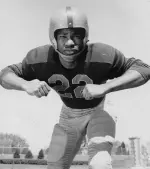
 Bobby Mitchell (22) takes it around right end for the Fighting Illini
|
|