28 Days of Black Excellence: A Q&A With Dr. Breanna Robinson
February 28, 2023 | General, Diversity, Equity & Inclusion
FEATURE
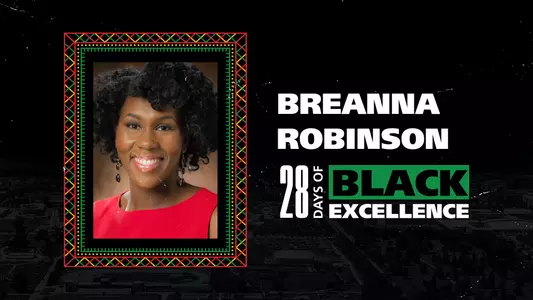
Dr. Breanna Robinson serves as senior associate director of athletics, diversity, equity and inclusion and sports administration and has worked at Illinois since August 2021. Dr. Robinson works closely with student-athletes and DIA staff within the realm of diversity, equity, and inclusion (DEI).
In honor of Black History Month and her countless contributions to Illinois, FightingIllini.com's Jackson Janes sat down with Dr. Robinson to discuss DEI, her collaborations with student-athletes, her accomplishments, how she defines progress, and her goals for the future.
This interview has been edited for length and clarity.
Q: What is DEI, and what falls under that umbrella?
A: Diversity is understanding that you need different people from different walks of life, different life experiences within your organization to make your organization better.
The equity part is really making sure not that everyone has the same things, but that everyone has the same opportunity to be successful. It's essentially making sure that people have access to the things that they need to be successful in a way that best suits them.
Inclusion is making sure that voices are heard, that people feel like they belong, and that there's a sense of community here. When you think about the different people that make up an organization, or the different people that walk these halls, and are in our athletic arenas, you want their voice to be heard and considered in the conversation. That's what we do in the DIA. That's the DEI piece.
Q: How would you define your role, and how do you implement those philosophies?
A: The way that we look at DEI within DIA is that it's not just my responsibility; it's a shared responsibility. Whether that is on the marketing side and what they're doing in-game or at athletic events, or you're talking about the pieces that we might write from a sports information standpoint.
It doesn't necessarily have to be DEI-focused education. It could be a number of things, making sure that they're seeing different people, hearing from different people to understand how different people operate and how different people are impacted and affected by the things that we do here, not only within athletics, but also outside of these walls.
Q: How often do you collaborate like with student-athletes, and what do those relationships look like?
A: A lot. I collaborate quite a bit with our Student-Athlete Advisory Council, and they have a DEI subcommittee as a part of their structure. I collaborate with those student-athletes. I'm really looking to them to learn more about their experiences, and that informs some of what we do across the department. We also have student-athlete affinity groups -- EMPOWER, International Illini, and Illini Allies. The Allies group is focused on LGBTQIA+. The International Illini is focused on meeting the needs of international students and building some community around that group. EMPOWER is meant to provide support to our student-athletes of color, whether they are Asian, Black, Indian, or Hispanic. It is providing support so those students can build some community and encompass their experiences.
What I look to do is not only collaborate with those groups, but also provide them with experiential learning opportunities. We want to be able to provide them with a learning opportunity, that education and have that full-circle moment so they're educating the next person, and then there's a ripple effect. There's a touch point with student-athletes, there's a touch point with the coaches. They have that touch point with me, and with other units like HR. There are touch points all over the place.
We also allow our student-athletes not only to connect just with me, but connect with different people around our department to see and understand how those other people impact their experience as well.
Q: Of the things you've accomplished and achieved, what would you say that you're most proud of?
A: I think that I'm most proud of the fact that there seems to be more people thinking about DEI without me having to interject and intervene. I'm really proud of the fact that people are coming to me to say, 'Hey, I have this idea. What do you think about it, or how can we take it and run with it?' I'm really proud of that, and I'm also proud of the progress that we're making on our DEI strategic planning efforts.
I think I'm really proud of that because when I first got here, it took some time to really understand DIA and campus and what those existing dynamics were. That has really informed how I position myself. Not just position myself within DIA but position myself to learn more and be more involved and engaged on campus.
Q: You talked about progress in terms of your strategic plan. How do you identify and define progress in that sense?
A: One of the ways that I'm defining progress is the steps that we've taken. We started with having conversations about key areas we thought we wanted to address and that led to an assessment. When you get to the point where you're doing an assessment, and you receive those findings, then formulate working groups to address those needs, to me that's progress. Those working groups are starting to meet and will providing recommendations. Those things are all ways that you are able to measure the progress.
If you've ever been a part of a strategic planning process, one of the hardest things is just getting started. It's figuring out where to start, and I think that that was a challenge in and of itself. Who's supposed to be in the room here as we're having these conversations? And then how do we activate those people who are in the room to then activate other people?' I've measured progress by not only the people that have been engaged, but also some of the things that we've been able to do along the way. Even though we're doing this strategic plan, we haven't halted anything. We've continued to make progress, and I think as we've gone through the process, we've been able to adapt, and come up with different ideas of how we can be better and more dynamic in the DEI space as we're doing it.
There's a part of it that feels like we're building the plane as we're flying it. but we continue to be able to make adjustments so that when we land this plane, at the end of the academic year, we can reassemble, refurbish, or just take certain pieces off and replace them with new pieces. It seems to me that we're really open to learning a lot about ourselves within DIA, but also constantly striving to make more progress and be better than we were before.
Q: What are some of your goals moving forward, both in the short term and in the long term?
A: In general, you see a lot of departments that do DEI, but I don't know if they have a plan of what that looks like. I think the goals that I have are really rooted in that strategic plan, of understanding the cadence of education and how to engage a broader audience, how to connect with our student-athletes and staff, and then build that bridge between the two groups.
I also think we need to figure out ways to really get our student-athletes to rise to the occasion and have them lead some of these initiatives. I think when some of our student-athlete affinity groups first came on the scene, they were strongly led by passionate student-athletes. My goal is to get momentum going with our student-athletes where they're the ones coming to me all the time and saying, 'I'm really excited. I'm really passionate about this.'
I think about how to then transfer and apply to what they're going to do in the real world after they leave. How does this apply to everything what you've set out to do?