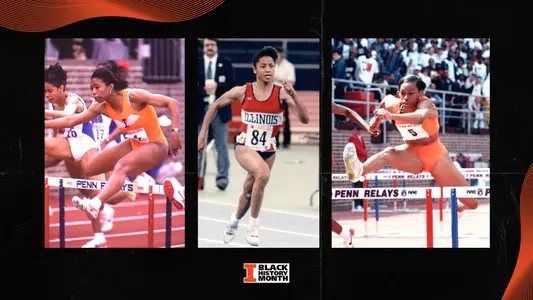
Mondie-Milner, Buford-Bailey and Williams Blaze Trails for Illini Track
February 23, 2021 | General, Women's Track & Field, Diversity, Equity & Inclusion
Feature
By Mike Pearson
FightingIllini.com
They were a trio whose cumulative accomplishments in the 1980s and '90s were truly monumental.
They combined for more than 60 Big Ten individual and relay championships, 42 All-America honors, three individual NCAA titles, one Olympic medal, nine first-place conference team trophies, and nine more conference runner-up finishes.
Absolutely no one can argue that these Hall of Famers -- Celena Mondie-Milner, Tonja Buford Bailey and Tonya Williams -- changed the face of Illinois women's track and field.
For a span of 10 seasons—from 1987 through 1996—these ladies helped Coach Gary Winckler's track and field teams achieve more success than any other Fighting Illini program.
***
It was Mondie-Milner who initially set the bar for all who followed her. The Milledgeville, Ga. native, one of the Big Ten's most dominating sprinters ever, was inspired at the age of eight to run track when she watched a movie about the legendary Wilma Rudolph. Overcoming polio as a child, Rudolph became the first American woman to win three gold medals in a single Olympics.
"I was just amazed at her sheer will to overcome so much difficulty to cope with in life and become the world's best female athlete," Mondie-Milner told writer Larry Watts in 2011. "That movie was just a defining moment for me."
Having already taken recruiting trips to Michigan State, Georgia and Georgia Tech, she had no idea that she'd eventually wear Fighting Illini Orange and Blue.
"I came up to visit Illinois on the coldest day of the year and there was snow everywhere," she told the 2011 writer.
That's when Winckler took Mondie-Milner on a tour of UI's famed Armory. Upon learning more about the University of Illinois' renowned academic offerings and the resources afforded to student-athletes, she cancelled her fifth recruiting visit (to UCLA) and signed on the dotted line with Winckler.
As a freshman in 1987, Mondie-Milner ran a leg on Illinois' championship indoor and outdoor 4x100-meter relay teams, then collected four more Big Ten titles as a sophomore. As a junior, she added six Big Ten trophies as a sprinter, then in 1990 as a senior, she won four individual and three relay championships.
"A lot of the ideas Gary generated were cutting edge for sprinters and hurdlers," she told Watts. "He was always trying to think of ways to get the athletes to be more efficient and train them to their fullest potential. No matter how painful the workouts were for me, I knew there was a method to his madness."
Mondie-Milner attempted to make the United States Olympic teams three different times—1992, '96 and 2000—but fell short each time. She also competed in the 1995 and '97 World Championships and won gold with the 4x100 team in '95 in Gothenburg, Sweden.
As an Illini freshman in 1990, Buford Bailey viewed Mondie-Milner, her senior teammate, as "a true role model."
"Celena was the one that I managed my life after in my first season," Buford Bailey said. "She worked really hard in practice, she had a great relationship with Gary, and she was successful. So she was the one that I latched on to."
Today, Mondie-Milner serves the University of Texas in Austin as its Executive Director of New Student Services.
***
Buford Bailey came to the U of I from Dayton, Ohio, the home of childhood hero Edwin Moses, the world's greatest hurdler.
"When I lived in Dayton, we drove down Edwin C. Moses Boulevard every day," she said "He was the reason why I ran the 400 hurdles."
Like Mondie-Milner, Buford Bailey was a devoted disciple of her Illini head coach.
"Gary wasn't just a coach for me," she said, "he was like a dad. I thought the world of him and I still do. Pretty much every piece of advice I got from him. I would have never had the kind of belief and confidence in myself as an athlete if it wasn't for Gary. I remember him telling me very early on that 'Those legs are going to make you some money one day' and I couldn't imagine that something like that could be possible. I always felt like if he believed in me, then I could do anything."
In Buford Bailey's four seasons at Illinois (1990-93), she captured an incredible 25 individual and relay team titles, had 10 All-America efforts, and was a four-time Big Ten track and field Athlete of the Year.
She says her best race was her 1992 NCAA championship in the 400-meter hurdles, the first-ever national title won by an Illini women's athlete.
"It wasn't even a race that I went into as the favorite," Buford Bailey said. "That's when I realized that I could really do well in that event. And it was the race that gave me the confidence going into the (Olympic) Trials that year."
She wasn't at all confident that she would earn a spot on the 1992 Olympic squad.
"Honestly, I was just thinking that it would be a good experience and that I would get to meet all these fantastic track stars," she said. "It was one of the first times that my entire family watched me race, so that was really fantastic. After the race, the officials gave the flag to Kim Batten, so I wasn't really sure that I had made the team. Then the results came up and saw that I got second, so I went running back out to the track and did a little victory lap by myself. It was so unbelievable."
Then, as a second-time Olympic participant at the 1996 Games in Atlanta, Buford Bailey took success one step further in the 400 hurdles.
"I actually went into that race thinking that I could win, so when I got the bronze (medal), I was very disappointed," she said. "I walked off the track really disappointed that I didn't win. Then, when we were underneath the stadium and they were getting us prepared for the awards ceremony, I looked around and said to myself, 'Hey, there are only three of us in the entire world (who were getting medals). It could have been worse … I could have been fourth.' That's when it sinked in not to take this for granted. From then on, I was never sad about my finish. Since then, I've always been proud to have won the bronze."
In 2004, at the age of 33, Buford Bailey returned to Champaign-Urbana to serve as Gary Winckler's assistant. Then, four years later, she became head coach of the Illini women's team.
"Gary groomed me to do that," she said. "I knew that one day I would have my own program. That was exciting. It was cool to be able to call my own shots and run the team the way I wanted to, to have my own philosophy and vision, and then to win some conference titles."
Buford Bailey moved on to the University of Texas where in 2016 she was named USA Track & Field's Nike Coach of the Year, becoming the first female to be honored since the inception of the award.
Today, she directs the Buford Bailey Track Club in Austin, Tex. and has been married to former NFL player Victor Bailey for 25 years. Her son, Victor Bailey Jr.—nicknamed "VJ"—is a redshirt junior with the University of Tennessee's basketball program. Her daughter, Victoria, is a standout volleyball player.
***
Tonya Williams was involved in a wide variety of sports as a child in Norfolk, Va.
"I wanted to play football, too, but they wouldn't let the girls play with the boys, so I lost that battle," she said.
Williams' youth coaches finally got her involved in track as a high school junior. A year later, she was taking recruiting trips in search of a college scholarship, first to Penn State, then to Illinois.
"Once I got to Illinois and visited with Gary and Ron (Garner) and Tonja, it just felt like home," Williams said. "Tonja, she was just so normal. To know that she had just made it to the Olympics and she was a big time track girl. She was just very, very humble … very sweet and welcoming. She's just always been that big sister that I never had. I felt so comfortable with her. I trusted her. Once I got there with Tonja, that's all I needed. She was the confirmation. She was a God send."
And like Mondie-Milner and Buford Bailey, Williams' respect for her head coach grew exponentially.
"I just loved Gary's approach with coaching … his specifics, the strategy, and how he broke everything down and made it so simple," she said. "It was a lot, but it was very simple. I loved how he explained our meals and our sleep and how that all factored in. He was a strategist and that was amazing to me. I didn't know a lot when it came to the dynamics of track and hurdling. To be honest, before I got to Illinois, I was just running for dear life and jumping over the hurdles. Gary specified the step pattern. His workouts were just amazing. It was truly an honor to run for him and the University of Illinois."
Williams says her most meaningful race was one that she lost in the 400 hurdles at the 1994 NCAA Championship.
"This may sound crazy, but my best race wasn't when I won the NCAAs," she said. "It was two years prior to that when I fell at nationals and I still got eighth place. That, to me, was the best race of my life. Not only did it teach me how much heart I had or how talented I was, it made me want it more. Gary showed me that race of me falling and getting up and finishing in eighth place, and he asked me 'When you fell, what were you thinking?' And in my mind, I was like 'Oh, I'm gonna catch somebody. I'm not going to be last.' And he said, 'Well, that's what you need to get back.' Because of that race, it helped me win the event the next two years."
Illinois' first two-time NCAA individual champ says she'll fondly remember her days as a young African American woman at the University of Illinois.
"With the world so crazy now and seeing so many things happening, I sometimes say I wish we could go backwards a little bit," Williams said. "I absolutely loved being at the University of Illinois. The black population wasn't many, but we all stuck together. Everyone was really nice and welcoming to us. I never experienced any type of racism or negativity at Illinois. It was a beautiful experience. Always. The coaches, our advisors and everyone in regards to our education were amazing."
Williams now resides in Fort Lauderdale, Fla. with her 12-year-old daughter and works in customer service for AT&T, supporting the state of Tennessee and some larger clients. A speech communication major at Illinois, she's confident that she'll eventually become a speech pathologist one day.
Williams says her life's proudest moment came three years when she was inducted into the Illini Hall of Fame.
"That was one year I'll never forget," she said. "It's a feeling that's unexplainable. The way they treated us and the way they rolled out the orange carpet for us, I have never been more proud. That's when I realized that I must have been really something."