Howard Milton: Breaking Barriers through the Art of Giving
February 14, 2021 | General, I FUND, Diversity, Equity & Inclusion
Feature
By Sean McDevitt
FightingIllini.com
Howard Milton, Senior Associate Athletic Director for Development, loves telling the story of his first day in the Development office. On that day, he was assigned an office but was told he had to kick an intern out. Milton politely asked the young man to move to a different desk by the copiers. The intern quietly gathered his papers and found his new seat.
Milton said, "He went on about his business, and I took my big plush office, never realizing he would have the grandest office in the building."
Of course, the intern was Josh Whitman.
Since Whitman took the reins as Athletic Director, Milton has led the fundraising efforts on program-changing projects, including the Henry Dale and Betty Smith Football Center, Demirjian Park, and the Susan and Clint Atkins Baseball Training Center, among many others. Over the years, Milton has helped set record-breaking fundraising numbers with no end in sight. The National Association of Athletic Development Directors (NAADD) named Milton the 2019 National Fundraiser of the Year.
Growing up the son of a single mother, he credits his upbringing for instilling the kind of drive and work ethic that has propelled him to be one of the top development directors in the nation.
"It goes both ways"
Living in the small town of Winfield, Kansas, Milton saw what a hard day's work meant to his neighbors and other townspeople. His house was next to a grain elevator, and he'd watch the men and their trucks go in and out of the co-op. However, it was his mother's hard work and giving spirit that was the real inspiration,
"My mom had a garden in the summers," said Milton. "I remember she'd get tomatoes, bell peppers, jalapeno peppers, and all that, and we would take bushels around to people. And then I also remember people showing up on our doorstep around Christmas. I really got to see what giving was in my small hometown. It goes both ways."
Milton played basketball and ran track in high school, but his mother pushed for him to be on the swim team. Milton said, "Because no one in my family could swim, my Mom thought it was important that I be on the swim team in the summers. It was a big deal because I was the only person that looked like me doing that."
"The world opened up"
"Going to Kansas was one of the best decisions of my life," said Milton. "The world opened up in front of my eyes there to see what was possible."
At Kansas, Milton took all the requirements to receive a minor in African American studies.
I was interested in my own history," said Milton. "It helped me understand the importance of identity and the importance of some of the contributions that African-Americans have made. It's hard when you don't see people in positions, such as teachers, nurses, police, business owners, whatever that don't look like you, and envision yourself doing that. Reading those books and taking those classes helped me identify what can be done and the greatness that has happened throughout history."
"Race has never been a limiting factor"
Before joining the Athletic Development staff, Milton spent his first four years at Illinois in event management. While serving in that capacity, he was the event management liaison to the Chicago Bears during the 2002 football season, as well as the Championship Director for numerous NCAA and Big Ten events hosted on Illinois' campus.
It was then time to make the challenging career jump to fundraising. In 2005, when he joined the Development office, Milton thought the department was daunting.
"I was scared to death because I had stereotyped everyone as being on the golf course in plaid pants, and that wasn't me," said Milton. "When I got an opportunity to really express myself and work with my love for people and talking to people and connecting, I realized it could be a good fit."
Milton also credits many people already at the DIA who helped pave the way, including high-ranked staff members of color like Terry Cole, Kelly Landry, Lenny Willis, and Shawn Wax.
"Illinois, at least for me, has led the way in this arena," said Milton. "Warren Hood, Dana Brenner, Ron Guenther, of course, led the way. Race has never been a limiting factor at Illinois."
"More people of color, more women"
You can count on one hand the number of African American Development Directors at the Power Five level. Some have moved on to become Athletic Directors or moved into other areas in college athletics. However, Milton believes the growth of representation in Development as a whole is incredibly positive.
"When I first started, there was hardly anybody," said Milton. "Now, the number of folks that are on staff and in the senior administration of development have probably quadrupled."
Going through the process to become the Senior Associate Athletic Director for Development was understandably intense, with multiple interviews and conversations about how important the position was to the overall goal of the DIA. As it went on, he better understood the vision and strategy Josh Whitman had for the department, and it meshed perfectly with how he saw the department's future.
Milton said, "Our vision is that we would have a development group that really valued relationships, engagement, and transparency. We challenged people to do more and visualize a new dream about what Illinois Athletics can be and what it could become. It seemed hokey because we had never done that before, but $300 million and seven facilities later, it didn't seem so hokey."
Looking toward the future is what Milton has always done, and Illinois Athletics is better for his vision of the future. Diversity is a strength, and the tent is only going to get bigger.
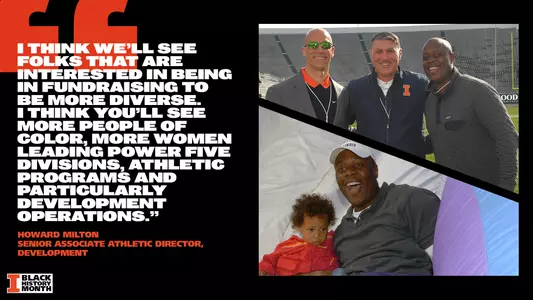
"I think we'll see folks that are interested in being in fundraising to be more diverse," said Milton. "I think you'll see more people of color, more women leading power five divisions, athletic programs and particularly development operations."