Hall of Famer Gia Lewis-Smallwood Believes Sports Can Lead Fight vs. Racism
June 10, 2020 | General, Women's Track & Field
By Sean McDevitt, FightingIllini.com
Sports, in many ways, is a unifying force. Fans come together to cheer on their team or favorite athlete. We marvel at the physical prowess put on display by men and women of all creeds and colors. Sports can bring everyone from all walks of life together in the enjoyment of competition.
Righting injustice can also be a unifying rally cry. In the last several weeks, we've seen it through millions of people around the world peacefully protesting. We see it in the streets as brave men and women from cities and towns all across the country come together to say enough is enough.
For the first time, people are learning no matter who you are, what you have accomplished, or where you live, systemic racism exists.
Gia Lewis-Smallwood, the most accomplished field event athlete in Fighting Illini women's track and field history, believes one small way to combat this problem is with sports. Named to the Illinois Athletics Hall of Fame Class of 2020, she recently spoke to the entire Department of Intercollegiate Athletics at the University of Illinois during a video call. Telling the story of her upbringing and how it relates to our current crisis, Lewis-Smallwood reminded us we are all just human beings looking for respect and dignity.
"My entire life has been around trying to succeed out of racism."
The Gia Lewis-Smallwood story begins with her parents, William and Delilah Lewis. Growing up in rural Georgia, they lived under segregation. They only attended black schools and met at an all-black college. Once married and looking to have a baby, their entire life revolved around beating systemic racism.
"From the time I was born, my mom was reading about cognitive brain development in the womb to make sure that your brain synapses connect appropriately and all the things that need to happen to make sure that the baby has perfect brain development," said Lewis-Smallwood. "When I was little, my parents would practice with me sitting still, because oftentimes when black kids move around in a classroom, white teachers assume that they're problematic. So from the time that I was a year old, I would have to practice sitting. By the time I was five, I could sit for three hours without going to the bathroom."
Another way the Lewis household would prepare for school was by getting the textbooks early. Delilah Lewis found a homeschool store using the same books as Gia's classroom. With textbooks in tow, the duo would get down to business.
"Every year in the summer, she would get the textbook for the next year, and we would learn a year's worth of material in three months," said Lewis-Smallwood. "So this whole homeschool thing that people are doing now, we did that all the time. Six days a week from 8:00 to 4:30. I went to every class knowing the information, knowing what to expect so that when I sat there, I could look at the teacher with complete bated breath as they talked. I could always raise my hand. I could always be engaged. I never was distracted."
Making these sacrifices and working so much harder than everyone around her was in service of one thing: trying to succeed out of racism.
"My entire life has been around trying to succeed out of racism," said Lewis-Smallwood. "I'm here to tell you; you cannot succeed out of racism. This is part of the problem that I feel is going on in this country. There's this idea; you look at people who are in pain, you're like, ugh, why can't they just do this? Why can't they just succeed their way out of racism? Believe me; I've tried."
"Systemic racism had taught me that everything was this long, drawn-out game with no end in sight."
The Lewis household was ahead of the curve in seeing sports as a way for better social and cognitive development. Once Gia showed an aptitude for running, she was encouraged to join track and field
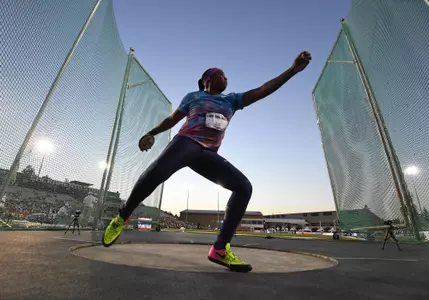
At Illinois, Lewis-Smallwood holds the record for the 20-pound weight throw and discus. She was the 2001 Big Ten discus champion and earned First Team All-America honors at the NCAA Outdoor Championships with a fifth-place finish.
"It was wonderful," said Lewis-Smallwood. "I adored my university experience. I have three degrees, and I was able to triple-major in political science, economics, and Spanish. That's why I graduated in five years here. I loved it. I loved the coaching staff, and I loved the people.
After graduation, Lewis-Smallwood became a four-time U.S. discus champion, while finishing second in 2010 and third in 2011. She competed at the 2012 Summer Olympics in the discus and holds the American record in that event with a toss of 226-feet, 11-inches. She won a bronze medal at the 2015 Pan American Games and finished fifth at the 2013 World Championships. Today, she is training for the 2021 Olympics in Tokyo.
None of it was easy. For years, she pushed herself to do better and be better to "succeed out of racism." It mentally wore her out.
Lewis-Smallwood said, "For about ten years when I was trying to be a professional athlete, I struggled. For many years I struggled because I felt like I didn't have confidence. The reality was I was exhausted. Systemic racism had taught me that everything was this long, drawn-out game with no end in sight. It probably took me the last couple of years to get all that figured out. I saw how systemic racism played into my life and played into my success."
"This is what our world needs, and there's no better people who practice this every day."
Coaches and athletes have a special bond. Lewis-Smallwood remembers growing up and seeing these interactions of real authenticity on the sidelines and in huddles. It takes an extraordinary level of communication to make a real connection, and she believes coaches can model this behavior.
"Right now, we are all struggling with how to connect with each other," said Lewis-Smallwood. "We do not have an accurate picture of each other's lives. Systemic racism must be dismantled. It comes from hearing stories like mine. It comes from listening to people, sitting on couches, looking in people's eyes, and backing people's human existence. Understanding why they are the way they are, not just looking at the highlight reel of their life."
Successful coaches have put countless hours into human relations and learning how to connect with other people. The idea that athletics can lead the way is exciting. Lewis-Smallwood sees coaches as the people who can move us forward and sports as the medium to showcase our humanity.
At the end of the video call, Lewis-Smallwood challenged DIA administration, staff, and especially coaches, "You can put a bunch of people together, and we can rally around something great, but if we don't have an accurate picture about what's going on for somebody. If we can't really look in their eye, sit on their couch, eat their food, and be committed to their existence as human beings, nothing will change. At least, in my opinion. This is what our world needs, and there's no better people who practice this every day."