Illini Trials, Tribulations and Triumphs
March 30, 2020 | Football, General
By Mike Pearson
FightingIllini.com
Over the almost century and a half that athletics has been on the scene at the University of Illinois, American life has been interrupted by monumental challenges.
World wars, economic crises, and troubling health pandemics have periodically reared their ugly head, but nearly every time the Fighting Illini have fought through those tragedies with a spirit of hope and optimism.
The United States' entrance into World War I on April 2, 1917, ultimately changed the lives of hundreds of UI students.
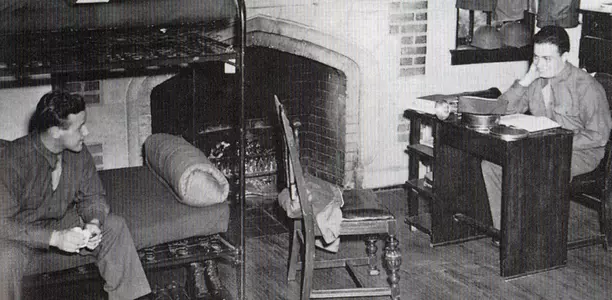
Then under the leadership of President Edmund James, the U of I offered the federal government an opportunity to establish a school of military aeronautics on campus. College men from various parts of the country were shuttled to Urbana-Champaign and the campus's Gymnasium Annex was converted into a gigantic aeronautics laboratory. Many were housed at the Armory that was transformed into a mammoth barracks.

Altogether, nearly 9,500 UI faculty, staff and students were in the service, including U.S. Navy enlistee George Halas and numerous Illini varsity athletes. Though Halas never encountered actual battle, his star football teammate Ralph "Slooie" Chapman did. On July 18, 1918, Chapman was riddled by machine gun fire from a low-flying German plan, crippling him for the rest of his life.
When the war ended on the eleventh hour of November 11, 1918, the campus's fatality list - including athletes Homer Dahringer and Edward Wallace - numbered 184.
Almost unbelievably during that same period - from January 1918 through most of 1920 - America and every other nation was enveloped by a deadly influenza pandemic that infected an estimated 500 million people and claimed the lives of well in excess of 50 million. By September of 1918, the University of Illinois also was enveloped by the disease.
Ailing students filled a variety of quarantined campus buildings, including the university's hospital, College Hall, Osborne Hall and the Beta Theta Pi fraternity. Emergency volunteers included athletics director George Huff, football coach Bob Zuppke, track mentor Harry Gill and a number of other Illini athletics staffers. They worked day and night to care for the campus's afflicted students.
Amazingly, the Illini football schedule proceeded as planned in 1918, but it did not do so without some major alterations to rules and regulations. Because of the shortage of male students, Big Ten faculty representatives adopted a resolution that declared freshman eligible to play football. The conference also temporarily agreed to be governed by rules of the War Department.
Individual football practices were limited to no more than 90 minutes and the conference eliminated games that required lengthy travel. On October 26, 1918, Illinois hosted the U.S. Naval Reserve School at Municipal Pier (Chicago) in a spectator-less game at Illinois Field. Because of the existing health fears, it's the only time in history that an Illini football game has ever been played behind closed gates.
With the war over and the health crisis mostly defeated, Illinois athletics rebounded with incredible resiliency in 1919-20, winning Big Ten and national championships in football, and placing second and third, respectively, in the conference's baseball and track and field competition.
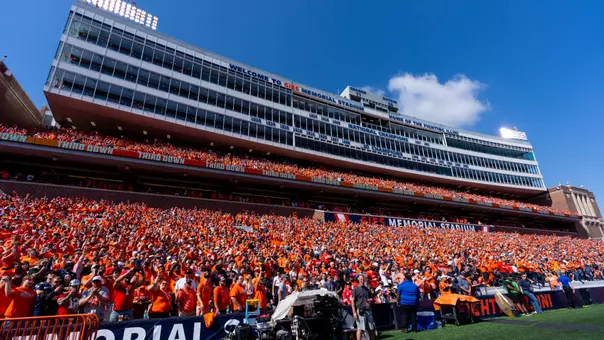
Sporting event attendance, particularly in football, surged at the University of Illinois. In April of 1920, UI Director of Athletics George Huff announced a massive fund drive for a new $8 million stadium, dedicating it to the memory of the university's fallen war heroes.

The beginning of World War II in 1939 covered another memorable period for UI's Athletic Association. Coach Doug Mills' talented Whiz Kids basketball team captured back-to-back Big Ten championships in 1941-42 and '42-43, but Uncle Sam snatched away most members of the all-star lineup before they could attempt a run at the national crown.
With the retirement of Zuppke and the ascension of Ray Eliot to head coach in 1942, the war years also altered the composition of the Illini football team. Roster-wise, Alex Agase, Tony Butkovich and four other Illini were ordered by the military to depart for Purdue where a Navy-Marine training school was based.
"We got nothing in return," Eliot told author Lon Eubanks in a book entitled The Fighting Illini. "The only military program on our campus was the Navy V-12, a non-collegiate service training, and those boys weren't allowed to go out for football."
Altogether, in 1943, between the start of Fall practice and late October, Eliot lost 25 players to military induction.
"We never knew who we'd have from one day to the next," Eliot remembered. "We had so many young and new players that we needed to have a system (the split-T offense) that we could teach in a short period of time and still have reasonably good execution."

Predictably, the toughest game the Illini played all season was against Purdue, a contest the Boilermakers easily won. Butkovich ran for 207 yards and four touchdowns, while Agase excelled on defense. Four other Purdue Illini - Joe Buscemi, John Genis, Frank Bauman and Mike Kasap—also played key roles for the Gold and Black.
When World War II ended, five of the six former Illini returned to Champaign-Urbana to play for Eliot's 1946 Big Ten and Rose Bowl champs. The only absentee was Butkovich, who had died heroically in battle in Okinawa.
The war also ended an eight-year existence for Illinois's polo team and a successful six-year run for ice hockey.
Today, 75 years after the end of World War II, another crisis (COVID-19) confronts Illini athletics. And though this pandemic has stolen the tail-end of intercollegiate athletics' winter sports season and the entire spring schedule, DIA administrators remain hopeful that the stoppage is only temporary.
After all, there are championships to be won!