July 16, 2019 | General
By Mike Pearson, FightingIllini.com
The following is part two in a three-part series telling the story of George Huff and his influence on University of Illinois history. He grew from a raw, strapping Champaign farm boy into a physically dominating athlete, then later evolved from a strategically talented coach into a visionary administrator.
But the full character of Huff extended far beyond the athletic fields and arenas. His is a story of a man consumed with loyalty, spirit, moral fiber and a deep respect for humanity.
In part one of this series, readers learned about Huff's family heritage and his early successes in life.
In part two, we provide details about the men with whom Huff surrounded himself and how he molded Fighting Illini athletics into a nationally prominent program.
888
PART TWO: Huff hires a transformative high school football coach
George Huff displayed a keen eye for character when it came to adding coaches to the University of Illinois's Athletic Association staff.
In 1904, just three years into his new job as athletics director, Huff hired 28-year-old Canadian Harry Gill to become UI's track and field coach. Twenty-nine seasons later, that hiring eventually resulted in an unprecedented 19 Big Ten and two NCAA titles.
Huff lured Ed Manley to Champaign-Urbana in 1912 to become the Illini swimming coach and that move provided Illinois with conference titles in each of his first two seasons.

Following a revolving door of basketball coaches, Huff settled on Ralph Jones in 1913. Two years later, UI enjoyed a perfect 16-0 season, including a 12-0 Big Ten mark.
Perhaps Huff's most ingenious hire was a German-born aspiring artist who had played collegiate football and basketball in his mid 20s at the University of Wisconsin.
Though painting was his first love, Robert Zuppke had to supplement his income as a high school coach, first at Muskegon, Michigan, then at Oak Park High School in suburban Chicago where famed author Ernest Hemingway was one of his players.
Oak Park and UI alumni Robert and George Carr brought Zuppke's expertise to Huff's attention in December of 1912 and arranged a meeting for the two men. "Zup" and "G" quickly identified and admired each other's character and personal styles, and soon settled on a three-year contract worth $2,700 per year (a purchasing power equal to $71,000 in 2019). Zuppke admitted years later that he had shunned more substantial offers from Northwestern and Purdue to instead coach the Illini.
With Huff's whole-hearted support, Zuppke's magnetic personality, inexhaustible work ethic and creative play calling soon began paying dividends at Illinois Field. A 4-2-1 record in 1913 blossomed into a Big Ten championship the following season. Huff was thrilled with the success of the football program and rapidly signed the then 35-year-old Zuppke to a new five-year contract that included a nearly 50 percent raise. Prosperity for the Illini gridders continued in 1915, finishing tied for first in the conference.
Meanwhile, on the baseball diamond, Huff's own teams flourished. His 1914 Illini club, bolstered by the pitching of aces Red Gunkel and Wally Halas (George's brother), captured its ninth Big Ten title. Illinois repeated as champs in '15 and '16, giving Huff 11 conference crowns in his first 21 seasons.
Construction was completed on UI's mammoth Armory in 1915, a season when Illini teams dominated Big Ten foes not only on the diamond, but in football, basketball, and track and field as well.
88
As World War I raged in Europe, the University of Illinois campus evolved into a training ground for soldiers. Most of UI's athletes eventually became involved with the military or with war industry, and the Armory was transformed into a giant barracks.
The year 1918 was one that Huff would never forget. His father, George Sr., died in April at the age of 76. "G" had inherited his spirit and unquenchable work ethic from his father, so the 46-year-old took his hero's passing with significant mourning.
By September of '18, an influenza pandemic had enveloped the entire UI campus. Ailing students filled a variety of quarantined campus buildings, including the university's hospital, College Hall, Osborne Hall and the Beta Theta Pi fraternity. Huff, Zuppke, Gill, Jones and other Illini athletics staffers worked day and night to care for the afflicted youngsters.

A local newspaper lauded Huff's personal efforts, writing "Mr. Huff was constantly on the scene, serving as a marvelous administrator and hurrying from one place to another in a frantic search for more doctors and nurses. Whenever new things had to be moved or some other task was at hand, he was always on the spot to see that it was done. Mr. Huff worked feverishly and many were the times that he didn't say goodnight until it was midnight."
Nationwide, the federal government reported that 675,000 Americans had died from influenza. In 1918, the City of Champaign Township reported more deaths (310) than births (301).
On November 11, 1918, an armistice ending World War I was signed. Of the 116,708 Americans who died in service, two Fighting Illini letter winners—Homer Dahringer and Edward Wallace—were victims. The patriotism of UI students and alumni would spur Huff on to a future project.
88
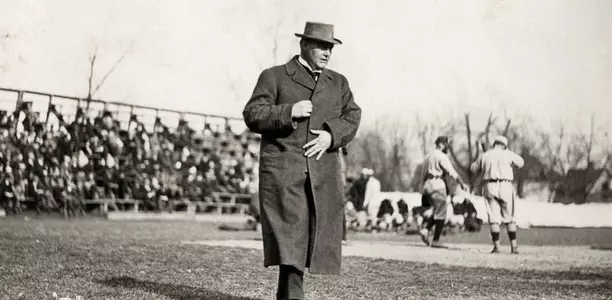
Growing weary from his ever-growing responsibilities as an administrator, Huff ended his distinguished Illini coaching career in baseball in the spring of 1919. In dominating fashion, Huff's final slate showed his teams winning nearly 70 percent of the 544 games he coached.
In the Fall of '19, under Huff's planning and supervision, the University of Illinois began offering a four-year course in athletic coaching, the first of its kind anywhere. Of the 136 credit hours required for graduation, students enrolled in the athletic curriculum had to complete studies in 34 hours of practical coaching and physical education. Among the initial graduates were Floyd "Shorty" Stahl, who went on to coach basketball at Ohio State; Otto Vogel, head baseball coach at Iowa; and Bernie Shively, athletic director at Kentucky for 30 years.
88
Later in the Fall of 1920, after an overflow crowd watched the Illini football game versus Ohio State at Illinois Field, Huff shared his newest dream with a local reporter, lamenting the deficiency of the Illinois Field facility.
"I haven't the slightest doubt that we could have sold more than 40,000 tickets, and possibly 50,000 if we had had the seating facilities," he said. "With the growing interest in our athletic teams, it is no idle guess to prophesy that a larger stadium is a necessity."
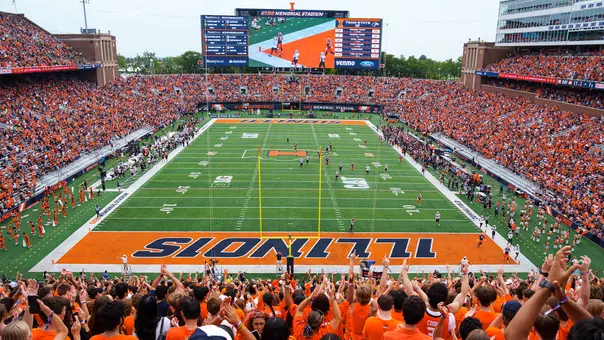
"Our stadium will be many things," said Huff. "It will be a memorial to the Illinois boys who were killed in the World War, a recreation field, and an imposing place for our varsity games. It will be an unprecedented expression of Illinois Loyalty."

Plans were immediately set in motion and selling the idea of a new stadium began.
Coming: Huff's accomplishments, his death and his indisputable legacy
SIDEBAR:
History Repeating Itself – Huff Battles the Threat of Gambling
On the heels of the infamous "Black Sox" scandal, a Major League Baseball incident in which eight members of the Chicago White Sox were implicated in purposely losing the 1919 World Series to the Cincinnati Reds, Huff became focused on stopping illegal gambling from infiltrating intercollegiate athletics. On the Illinois football team's trip to play Ohio State, Huff had personally witnessed how Columbus hotels were converted into betting rings for wagering on the game. It disgusted him
Said Huff, "Betting on the success of the Orange and Blue defenders should never be tolerated. Leaders should do their utmost to prevent such a practice from creeping into our university athletics. I have always been opposed to student gambling and wish to see it entirely banished. (Gambling) is a practice out of keeping with the high ideals and standards of students at Illinois."
"The gambler," Huff continued, "is the greatest foe of athletics that there is. Gambling has ruined every sport upon which it has taken hold."
Dean Charles Thompson of UI's College of Commerce joined forces with Huff, saying "Professional gamblers will kill football just the way they did horse racing, boxing and baseball. Student opinion is the only thing that can save football. If the students would get together and ride the first professional gamblers out of town on a rail, they would soon be free from the taint of gambling on football."
Soon after, Champaign-Urbana's business community jumped aboard and a placard was posted in every hotel and billiard hall:
IN ORDER TO DO ITS PART TOWARD PROTECTING COLLEGE SPORT FROM HARMFUL INFLUENCE, THIS PLACE WILL REFUSE TO HOLD BETS ON UNIVERSITY OF ILLINOIS ATHLETIC CONTESTS!
Furthermore, Huff's anti-gambling program provided for a "blacklist" of all students, alumni or citizens caught betting on games or scalping tickets. The list was to be published and guilty persons were never again to be allowed to purchase an athletic ticket from the University. Students apprehended scalping tickets were subject to expulsion from the University and were blacklisted if caught betting on or off the campus.
Huff's drastic measures proved to be effective. Betting and ticket scalping were held in check and other universities around the conference and the nation soon got in step by employing similar measures.