The Origins of University of Illinois Women’s Athletics
March 10, 2022 | General, Title IX
FEATURE
By Mike Pearson
FightingIllini.com
It took more than a century after the University of Illinois first admitted female students in 1870 for there to be equality among the sexes in intercollegiate athletics.
As a writer for UI's yearbook expressed in the 1905 edition of The Illio, "Better results are obtained in women's athletics every year, and it is hoped that, at some near future time, the girls will equal the boys in athletics."
It's not that Illinois was different from any of the other universities across the country. In fact, the sports chronology for women was nearly identical to its collegiate counterparts.
By 1874, a calisthenics program for women was created and by 1896 "club" sports began appearing at the U of I. It was then when Illini women hosted Wesleyan College in basketball at Urbana and beat them by a score of 28-14.
Somewhat surprisingly, women were initially more active than men in the new-fangled sport of basketball, invented by James Naismith in 1891. Women's athletes, known then as the "Illinae", wore black bloomer suits as they tossed the ball into peach baskets.
Said The Illio, "Everyone was delighted with the agility, nerve and skill displayed by the young women, and their perfect management of the game."
The campus's "he-men", it was said, looked down on basketball as a "silly game", one fit only for coeds. Their attitude eventually changed and men made it a varsity sport in 1905-06.
An organization called the Women's Athletic Association (WAA) was formed in 1903. It began with a couple dozen members and expanded to more than 200 by 1920. The number of sports offered to women's athletes expanded markedly by 1927 when four-sport seasons were established. A woman was allowed to participate in one major sport (field hockey, soccer, basketball, volleyball, swimming, baseball and track) and one minor sport (tennis, golf, rifle shooting, bowling, hiking and something referred to as apparatus).
By 1915, Louise Freer was named the first head of physical education for women. She oversaw the WAA from 1915-1949 and oversaw the first major "I" letter awards to WAA members for athletic success in 1919.
A 1923 WAA handbook suggested that women athletes get eight hours of sleep, not consume coffee or tea or eat between meals, and take a hot shower followed by a cold one after every practice and game.
During the decade of the 1930s, the first stand-alone gymnasium for women was constructed, but there was a trend away from intercollegiate competition for women because of a fear of rivalry and professionalism. Typically, several colleges competed at one site. At the same time, participation in intramurals saw increased numbers.
A Daily Illini article said that the philosophy of female physical educators was that collegiate sport and the WAA "should be recreational and enjoyed by many women." They strongly disapproved of the selection of a single group of highly skilled players.
In the 1940s, '50s and '60s, the trend of women's athletics swung toward extramural competition, primarily due to the equalization of sports opportunities for women and men.
A person who was on hand for nearly 40 years as a member of the UI's women's physical education staff was Carita Robertson. In a 1975 interview, Robertson said participation was popular because "there weren't so many things to do around campus back then."
In 1952, the WAA became the WSA (Women's Sports Association) because, as a campus leader explained, "The philosophy of the program really was sports rather than athletics. Athletics weren't accepted for women. The students coached themselves and the coach was more of an advisor."
In 1964, the organization's title changed again, this time to the Women's Extramural Sports Association (WESA) in 1964, under new director Helga Deutsch.
Karol Kahrs, director of the WESA from 1966 to 1970, said the organization's objective was maximum participation or all women students.
"Developing leadership and social abilities were emphasized," Kahrs said. "Winning was de-emphasized."
WESA evolved into the Women's Intercollegiate Sports Association in 1973 and had to drop four of its nine sports due to a lack of funds. A year later, women's sports would get a much-needed injection of support.
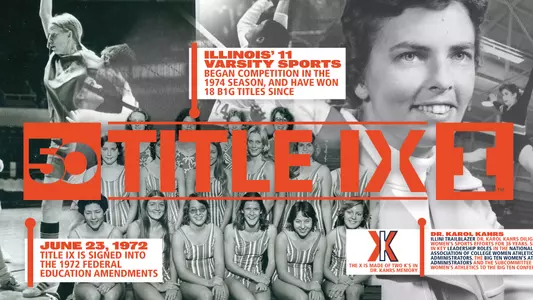
The final title change occurred in 1974, two years after United States Congressmen passed the Title IX Amendment in the summer of '72, signaling legal equality of the sexes and prohibiting discrimination on the basis of sex. In June of 1974, women's varsity athletics was adopted by the Athletic Association, forerunner of the Division of Intercollegiate Athletics.
Seven sports—volleyball, golf, swimming, basketball, tennis, gymnastics and track and field—officially launched in the 1974-75 season and life would never be the same for women's athletes at the University of Illinois.