THE STATE OF THE ILLINI | PART 3
June 28, 2021 | General
By Mike Pearson
FightingIllini.com
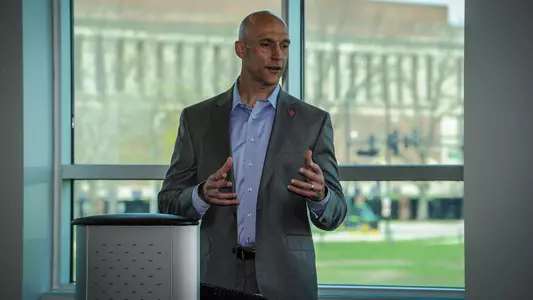
NOTE: In mid-June, University of Illinois Director of Athletics Josh Whitman met with reporters from around the state for his annual media roundtable. The conversation included subjects not only about actual competition, but also about the numerous consequential issues encircling the world of intercollegiate athletics.
In part three of this four-part series, Whitman presents his views about the problematic issues (Alston vs. the NCAA, name/image/likeness, gambling, the open transfer landscape, etc.) that could have a monumental impact on the future of Fighting Illini athletics.
Josh Whitman longs for the simpler times of yesteryear when the primary focus of an intercollegiate athletic director's agenda centered around his student-athletes' performance on the fields and courts, and in the classroom.
My, oh my, how times have changed.
While the popularity of college sports continues to soar, there are so many issues that threaten to upset the proverbial applecart.
Alston v. the NCAA
Earlier this week, for the first time in four decades, the United States Supreme Court ruled on a case that could be incredibly consequential regarding the future of intercollegiate athletics. The plaintiffs in "Alston v. the NCAA" were former student-athletes, while the defendants were the National Collegiate Athletic Association and most of the conferences at the Division 1 level.
The case is essentially an anti-trust lawsuit. The plaintiffs claimed that the NCAA, with its rules that limit the value of student-athlete compensation to the value of a scholarship, are by default a violation of anti-trust law. Anything that is seen to restrict competition in an otherwise open marketplace is seen as a potential violation. In basic terms, it relates to what a university can pay a student-athlete. Currently, NCAA rules limit that compensation, i.e. tuition, books, fees, room, board, and, in recent years, a cost of living stipend … what the University of Illinois can directly pay student-athletes for their participation in its program.
On June 21, after hearing arguments from both sides, the Supreme Court ruled unanimously (9-0) in favor of the plaintiffs. Following the ruling, the Big Ten released a generic one-sentence statement: "The Big Ten Conference and our member institutions are reviewing the implications of today's Supreme Court decision in the Alston case to determine the best path forward for our student-athletes and for Conference athletics generally."
Said Whitman, "This ruling could have far-reaching implications for college athletics."
Name, Image and Likeness
The basic definition of Name, Image and Likeness (NIL) relates to what a third party can pay a student-athlete for what could traditionally be considered an endorsement deal.
"The preference here at the University of Illinois, and the preference of most of our colleagues across the country, has been and continues to be what I would term to be a national solution,"
Whitman said. "Whether that solution comes through NCAA rules making or federal legislation, we certainly would prefer to see something done at the national level that provides an even playing field across the country.
"It became clear that July 1 is the unofficial deadline for NIL," Whitman continued. "There were a number of states across the country that had passed legislation with July 1 effective dates. We've wanted to give these national solutions an opportunity, dating back 18-24 months ago, but as that date approaches it became apparent that if we didn't take some action that our student-athletes would be disadvantaged and our athletic program would be disadvantaged. So, we're very grateful to Speaker (Chris) Welch and Representative (Kam) Buckner, a former football player at the University of Illinois. We appreciate their guidance and leadership in pushing through what I believe is a very thoughtful and comprehensive bill that deals with this very nuanced issue.
"It does have a July 1st effective date, assuming that Governor Pritzker will sign it in the next few days," Whitman said. "The uncertainty of it is a little unsettling because we don't know exactly how it will work out. This is an entirely new frontier and one of the biggest changes to come to college athletics in modern memory. We've got a lot of efforts internally to provide assistance, guidance and monitoring, all of the things that are going to be necessary in this new landscape. We'll help our student-athletes as we can and we'll hold on tight as we see how this ride goes in the future."
Sports Wagering
Sports wagering in the state of Illinois began in March of 2020 and online sports betting went live the following summer. This past April, Whitman addressed the Illinois House Executive Committee to oppose lifting the prohibition on gambling on in-state colleges and universities.
"We remain strongly opposed to that," Whitman said. "It's worth noting that this opposition is not just my position but also the position of every Division 1 athletic director in the state of Illinois. Candidly, I struggle to see the 'why'. I don't know why we're trying to change this particular part of this law which is just two years old. We, as administrators in college athletics, are always looking out for what we believe are the best interests of our student-athletes. This is one of those areas where there is a strong line to be drawn between professional and collegiate athletics.
"I have no problem with betting on professional sports, but in the college space it's entirely different. In large part, these are kids who are 18-20 years old. They're living on a college campus and surrounded by people every day who may be betting on them. How strange is that? To be sitting in a classroom next to someone who might be placing a bet on how you're going to play that night. Or, to live in an apartment knowing that the guy next door is watching you walk out of your room … are you on crutches? … are you sick? … to know whether they should put money down on you the night you go out to play. It's a little awkward that in the state you have to be 21 years old or older to gamble on sports, yet we're contemplating opening up an opportunity to gamble on people who aren't even old enough to gamble themselves.
"We do have significant concerns around the mental and physical health of our student-athletes. The rancor that some of our fans feel toward our student-athletes when they struggle is disturbing. If you open the door wide to gambling on them, you're just inviting more of that commentary directed toward our student-athletes. The narrative that's directed at them when they miss a shot or drop a pass or when they miss a kick … you wouldn't believe it. So, anything we do that's going to create more of that doesn't make any sense. That's why we continue to oppose it. I tip my hat to my colleagues across the state. There are 13 of us that represent Division 1 institutions and all 13 feel similarly about this particular issue."
Open Transfer
"Obviously, it's a new day," Whitman said. "This is something that has been the rule for almost every sport for years and has gone without much mention. The one-time transfer opportunity that's available to every student-athlete is good. Everyone should have that same opportunity. It shouldn't matter what sport you play, so it no longer made sense for us to distinguish some student-athletes over others.
"I support the transfer, but it is challenging," Whitman continued. "There are over 1,600 men's basketball players in the transfer portal right now. Of about 350 schools that play basketball, it's an average of more than four per school. It has created a level of instability in the system that I hope will subside over time. Right now, the transfer portal is the new shiny toy. Everybody thinks that it's the place to be. Over time, a lot of our student-athletes will realize that maybe it's not all that it's cracked up to be. Over time, we'll find out that everyone that's placed themselves in the portal won't have a place to go. It's a bit like musical chairs in that not everyone's going to have a place to sit down when the music stops. As things normalize over the next year or two, hopefully we'll see less activity in that portal than we are right now.
"Open transfer could have a dramatic impact on high school athletics," Whitman said. "There is a cost-benefit analysis to be done by every coach. You can spend years and lots of money recruiting a high school athlete. They come, they enroll and then they depart. Versus recruiting a transfer, that process is much more expedited. It's a period of weeks, not years. They're a little more mature and they have a better sense of who they are and what they're looking for. You don't have to outlay the same kind of expenses in traveling around the country to visit with them or watch them play. And because of the one-time transfer rule, once they come to you, they're yours. So, there's a dynamic that is going to come into play as our coaches make decisions. High-level high school recruiting will always be at a premium. There's no question that rosters will become more heavily populated with people who have come through the transfer portal than they ever have."
Part four of the series will detail Josh Whitman's optimistic view about Illinois' football and men's basketball's prospects in 2021-22 and beyond.