Former Illini Gymnast Develops COVID-19 Breath Test
November 18, 2021 | General, Men's Gymnastics
Feature
By Sean McDevitt
FightingIllini.com
It started with a tumbling class at the local YMCA.
John Redmond grew up playing baseball, football, and basketball. None of them stuck. During his sophomore year in high school, he finally decided he wasn't going to be a good football player, and he never really liked baseball or basketball.
He decided he was going to be a gymnast, and that made all the difference.
Today, he is working on making a difference for millions of people by introducing a pioneering portable way for people to detect COVID-19 just by analyzing their breath.
"You can create your best self…"
Growing up in Olympia Fields, Illinois, Redmond had a typical suburban childhood. Through the years, he gravitated toward athletics.
"Today, kids are highly specialized," Redmond said. "Back when I was growing up, you played baseball, you played football, and you rode your bike, you hung out, you went to the mall."
It took a while, but it all fell into place once he decided to focus on gymnastics. Having a family that owned a gym certainly helped.
Redmond said, "It was pretty easy to kind of lean in on gymnastics because the rest of my family was there all the time anyway."
His first gymnastics class progressed into a boy's program, with Redmond being one of the first to join. As he saw progress each day, he was hooked. Opportunities to learn and train with other coaches and gymnasts became available, and Redmond took advantage.
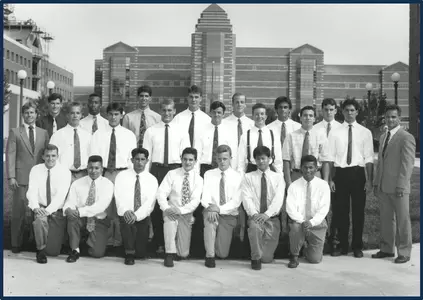
As a club gymnast, he looked for university programs that held camps in the summer. In high school, Redmond went to the Illinois camp and started a relationship with Head Coach Yoshi Hayasaki and Illinois Gymnastics.
During his 35-year tenure at Illinois, Hayasaki led his teams to six Big Ten Championships and won NCAA national championship in 1989. He coached over 90 All Americans, 50 Big Ten champions, 12 national champions and produced 3 Olympians. For Redmond, it was a relationship that turned into a career at the University of Illinois as a student-athlete. It was something he wasn't sure would be available to him.
"I was not being highly recruited as a gymnast," said Redmond. "I had an opportunity to go to West Point, but I wasn't really interested in a service academy at the time. Because I had a relationship with Yoshi, I basically wrote him and said, 'Hey, if I had an opportunity to come to Illinois, not at your expense, could I walk on?' And he was like, 'Of course.'"
When Redmond was a senior in high school, the 87-88 team came in second at Nationals and returned several star student-athletes. The opportunity to go to a winning program as a walk-on was exciting.
Redmond said, "You can create your best self from an athletic perspective because you're training at a level that, at least for me, was significantly different from the club I came from. I was training with some of the best athletes in the world at one of the best facilities in the world with men that are good at their craft. That was amazing. As a freshman, I got stronger and more flexible than I had ever been in my life as an athlete."

Along with the athlete part of being a student-athlete, the student part was equally important. And managing time because crucial.
"The hardest part of college, and I tell this to kids today, is time management," said Redmond. "The beauty of being a student-athlete is you're forced to manage your time because we practiced every day. From 2:30 until 6:30, I was busy, which meant with my class schedule, I had to take classes from 8:00 in the morning until about 1:00 or 1:30 in the afternoon. You grab food, go to the gym, get home, take a shower, study, rinse, and repeat. The structure helped me because it was very easy to adapt to college life. After all, I had a built-in set of friends, but I also had a built-in set of guardrails in terms of time management."
"Our professors were preparing us for real life…"
Looking back at his days in the classroom, Redmond sees how his professors set up their students for success.
"Our professors were preparing us for real life in the business school," said Redmond. "They were exposing us to case studies and to market research that was applicable to where many of us thought we were going to end up in corporate America. Having an undergraduate business degree from the University of Illinois, well-prepared us to go and do entry-level kind of stuff in the real world."
After graduation, Redmond worked at the family gym for a year and a half but wanted to strike out independently. He looked at sales positions and found himself working at a search firm.
Redmond said, "Recruiting is sales, first, and the human resources stuff is second. Working in a search firm to start my career gave me a solid foundation for 20 plus years of human capital consulting, talent acquisition, diversity, and inclusion."
Diversity and inclusion are essential factors in Redmond's life.
"We were one of very few black families in the area where I grew up," said Redmond. "As I transitioned to middle school, obviously, there were a few more. By the time I got to high school, there were a lot more, but they didn't come from the same neighborhoods. They didn't have the same background, and they didn't have the same experience and exposures that I had. Getting into the corporate world, you see that. We've evolved from diversity to inclusion to equity and belonging. And I think that's kind of cool because you just want to bring your whole self to work, and you want to feel like you are part of something."
"I'll be able to tell you whether you have COVID…"

In 2018, Redmond co-founded and is president of InspectIR Systems, LLC. His company has created a patent-pending real-time mobile testing device to detect hundreds of volatile organic compounds on the breath, such as illicit drugs, Influenza A, COVID-19, and more in as little as 90 seconds.
Redmond said, "We asked what we thought was a fairly simple question, which was, 'can you create a marijuana breathalyzer?' And it turns out the answer is yes."
When COVID-19 hit back in March of 2020, the company turned its attention toward other respiratory illnesses and if their instrument could detect them in the breath. They spent the last 20 months looking for and finding the unique breath print of COVID 19 via non-invasive breath sample, and the company is currently awaiting FDA Emergency Use Authorization.
"We're waiting on FDA approval, but we're looking at additional upper respiratory infections," said Redmond. "So, I'll be able to tell you whether you have COVID, whether you've got the flu, whether you've got something else, potentially strep throat, maybe pneumonia. The flu kills a lot of people, and it's not that COVID kills more or less; that's not my point. My point is that there's a lot of bad things in the world, and unhealthy people are disproportionately affected by viral infections, whether it be COVID, whether it be the flu, whether it be pneumonia."
The future use of these instruments can potentially change how people manage being sick. One of the goals of the company is to become a default rapid diagnostic tool. By blowing into the instrument and getting an actual diagnostic result, individuals can make their visit to the pharmacy, convenient care, or their doctor that much better. It makes telemedicine and telehealth more beneficial.
Redmond doesn't get back to the Illinois campus often, but he was able to come back during the testing phase of his breathalyzer device. He said, "When we were doing clinical trials, the head trainer there at Illinois was gracious enough to allow us to come to the football program and test some football and volleyball players that were back on campus for summer training."
The future is bright for InspectIR Systems. Redmond sees potential on the horizon, "Our patent protects us globally, around blowing breath samples into the instrument. I would tell you, going forward, we will look at opportunities to capture environmental air samples, smart buildings, and more."