Support System Helps New Illini Succeed
August 17, 2016 | Football, General, Men's Basketball, Softball, Swimming & Diving, Hometown Heroes
Seminar, mentors assist first-year student-athletes as they adjust to university
Jalen Coleman-Lands expected being a student-athlete at the University of Illinois would be tough. Even so, he was overwhelmed at times by the dual demands of studying and playing basketball at the university once he arrived last year.
"It was a little bit more than what I expected," Coleman-Lands said. "I didn't really understand the work it takes to get the results you want."
Coleman-Lands wanted to excel in the classroom and on the court but struggled at first to balance his academic and athletic responsibilities as a freshman, sometimes turning in an assignment late or arriving late to a pregame shootaround. Over time, however, he adjusted to the rigors of studying at a top-tier school while competing in the Big Ten. For that, he credits his coaches and academic counselors as well as two relatively little-known parts of the university's support system for student-athletes: The Student-Athlete Seminar and the Freshmen Athlete Mentor program.
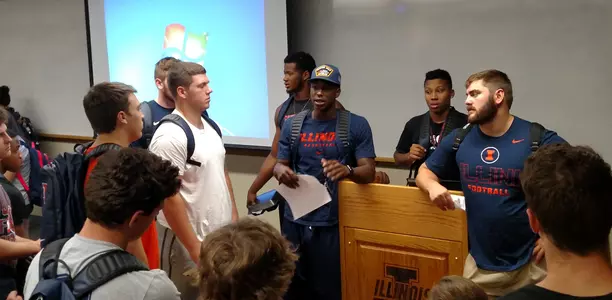
The seminar, which all student-athletes are strongly encouraged to take in their first semester on campus, is designed to be a crash course in everything they need to know to successfully transition to the university. Among other activities, incoming Illini in this summer's seminar:
- Learned study skills from the athletic department's academic services staff
- Talked about what it means to be an Illinois student-athlete with athletic director Josh Whitman ("If you bring an intensity to your daily work here as a student, as an athlete, as a person, you will reap the benefits of that literally for the rest of your life," he told them.)
- Received guidance on appropriate use of social media from campus experts
- Explored diversity by visiting the university's cultural houses
- Discussed healthy relationships with staff from the Women's Resources Center
- Were introduced to the department's Hometown Heroes community service program by assisting at a camp for youth with diabetes
- Studied the university's history by going to significant sites on campus and reading about former Illini football star Red Grange
- Reflected on what they want to do in their time on campus and beyond by writing an essay and giving a presentation.
A component of the seminar is the mentor program, in which returning student-athletes volunteer to consult with their freshman counterparts, welcome them to the Fighting Illini family and help them acclimate to the packed schedules and intense pressures of life as a collegiate student-athlete.
Coleman-Lands said the seminar, offered annually in the summer and fall, helped him meet people, gain exposure to various majors and learn about the resources available on campus. He especially remembers hearing guest speaker and former Illini basketball standout Dee Brown talk passionately about his experience as an Illini and exhort today's student-athletes to take full advantage of their time in Orange & Blue.
"It alerted me to what was here," Coleman-Lands said.
As he honed his time management, organization and communication skills, Coleman-Lands said, he found he could succeed in both the athletic and academic realms. On the court, he scored 10.3 points per game last season while setting a school record for 3-pointers by a freshman. Off the court, the sophomore from Indianapolis recently was admitted to the university's prestigious College of Business and applied to mentor this year's crop of freshman student-athletes.
He and his fellow mentors (all of whom who must apply and complete training to participate) regularly visit the seminar to share their wisdom. They also make themselves available to interact and answer questions outside the classroom.
The athletic department has offered some of the kind of programming included in the seminar for years but began providing a concentrated dose via a credit-bearing course through the Department of Recreation, Sport & Tourism about three years ago, said instructor Dr. Michael Raycraft. The mentor program was added in 2013-14.
Raycraft said it's important for student-athletes to learn how to handle the challenges and opportunities they will encounter as they become the next generation of Illini and community members.
"When they walk out of a class like this, I want them to be well equipped to be successful in their academic pursuits on this campus," said Raycraft, who teaches the course in collaboration with the athletic department's academic services and student-athlete development staff. "They need to have an appreciation for the unique role of the student-athlete and an appreciation for the traditions of our campus."
Freshman softball player Akilah Mouzon of Newark, New Jersey, is one of 53 student-athletes in the seminar this summer. She was afraid she would have to figure out how to juggle her sport and her studies largely on her own but has been pleasantly surprised by how much support she has received.
"Since being on this college campus, I have learned that my previous fears are no longer valid," Mouzon wrote in an email. "There are a lot of people here at U of I that are supportive of us and try to help."
Those people include fellow student-athletes such as Nelly Casas, who wanted to become a mentor because she appreciated having an older student-athlete to assist her as she first navigated the university.
"It was someone I could relate to right off the bat that would go through similar things as I would, a person that I could always talk to and ask for help," Casas, a junior swimmer from Oswego, wrote in an email. "I wanted to be that person for someone else."
Coleman-Lands said he hopes to help his mentees – a trio of freshman football players -- avoid some of the pitfalls he encountered as a freshman. He contacted them before this summer's seminar to begin to build a relationship, and he plans to stay in touch after the course, which ended earlier this month. So far, he has visited with them in the dorms, hung out with them at the Activities and Recreation Center, walked with them around campus and connected with them via phone and text. He has advised them on issues ranging from how to manage academics and athletics to how to get around town.
"I feel like I can help my mentees out," Coleman-Lands said, "so they won't have to suffer from as many mistakes or go through as many mistakes as I did."