Memorial Stadium: Dedication Game
5/21/2024
In October of 1924, the headline makers included President Calvin Coolidge, the man who presided over the 114 million citizens who inhabited the United States of America. Walter Johnson led the Washington Senators to baseball’s World Series title, while Buster Keaton and Rudolph Valentino were two of the silver screen’s most prominent stars.
In Champaign-Urbana, the new Illinois Central Depot had been recently completed, and the tracks that had separated the community for 70 years were finally elevated. And, to serve the approximately 9,000 students at the University of Illinois, construction of the new McKinley Memorial Hospital was underway.
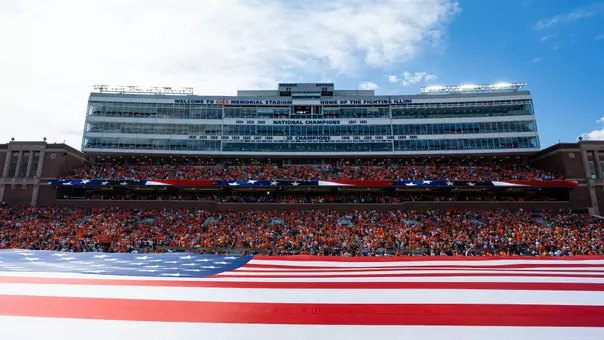
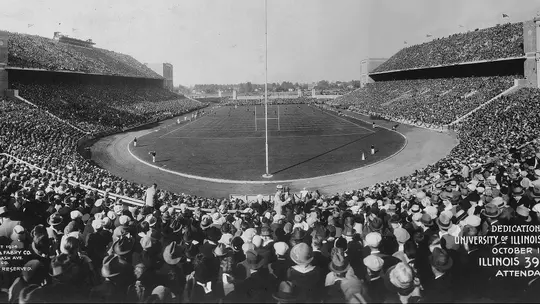
On the southwestern side of campus, finishing touches were being applied to the stadium that had hosted its first game in November of 1923. Stadium dedication weekend – Oct. 17-19, 1924 – saw 40 trains draw thousands of football fans from Chicago, St. Louis and beyond.
University classes were cancelled and offices were closed on Friday the 17th to enable them to attend the dedication exercises. A parade headed by former servicemen led more than 15,000 students, graduates and visitors to the ceremony, officiated by University President David Kinley and director of athletics George Huff.
“Dedication of the stadium is our eternal rejection of the philosophy of brute strength,” Kinley said. “This stadium is a memorial to those of the university who died in the world war. We cannot hallow it by our words, but they have hallowed it by their deaths in defense of ideals and principles in which they believed. It is for us to keep it hallowed by living those principles. The uses to which this great structure are put must be uses which exemplify those principles.”
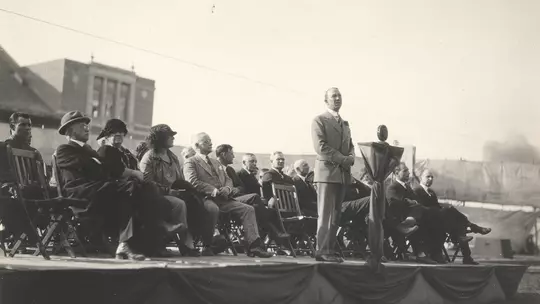
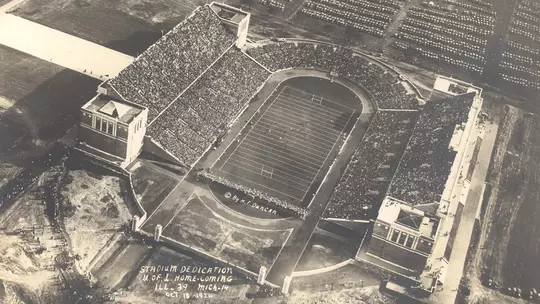
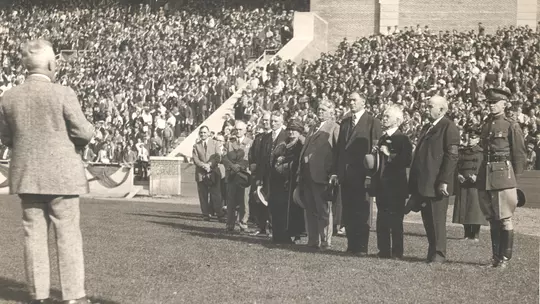
Following Kinley’s address, the names of the 185 war dead to whom memorial columns were dedicated were read, then UI graduate Lew Sarett delivered his “Ode to the Stadium.”
Rooms were extremely scarce. The visiting Michigan Wolverines football team was quartered at the Urbana Country Club, while the Fighting Illini stayed at the Champaign Country Club. Less than one thousand of the estimated 50,000 out-of-town visitors could be accommodated among the community’s sparse number of hotels, so more than 500 local residents made private rooms in their homes available. Campus sorority and fraternity houses installed lines of cots to accommodate their friends and family, while the remainder was forced to seek lodging as far as 75 miles from the stadium. Several others had no other choice but to sleep overnight in their vehicles.
More than 30 Chicago police officers were brought in by Champaign-Urbana administrators to assist with traffic control.
Wrote the Chicago Tribune, “There were almost as many motor cars in Champaign as there are in all of Europe.”
U of I concessionaires, according to The Daily Illini, ordered 40,000 hot dogs, 2,000 bags of peanuts, and thousands of gallons of beverages for the massive crowd to consume.
On Saturday, Oct. 18, a 70-degree autumn day greeted the largest crowd (67,886) ever assembled for a State of Illinois athletic event.
Stadium workers draped Orange and Blue bunting in front of the east and west stands. The gridiron’s grass was so immaculately manicured that one reporter described it as “emerald velvet.”
Anxious ticket holders arrived early to locate their seats. Others roamed among the twin colonnades to pay their respects to fallen friends whose names appeared on the 200 limestone columns.
Little did fans realize that they would soon witness the greatest display of offense in the youthful history of collegiate football.
Inside the Illini locker room, head coach Bob Zuppke addressed his troops.
“Zuppke had our team up very, very high,” recalled then-Wheaton junior running back Red Grange years later. “I don’t think, on that day, that any college team in the United States could have licked us. We felt that we wouldn’t be defeated; that was for sure.”
Just before 2 o’clock, a bugler from the Illinois band stepped to the base of the flagpole, and the crowd rose to its feet as Taps was played.
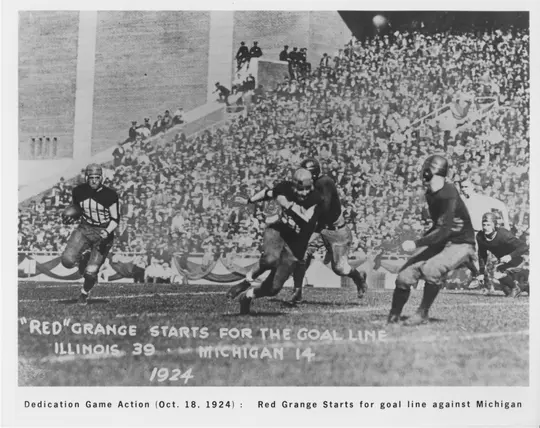
Finally, it was time to ball. From the opening kickoff, Grange proceeded to tear Michigan’s vaunted defensive to pieces. He gathered UM’s first boot at the 5-yard line and dodged Wolverine tacklers on a scintillating 95-yard run for the game’s initial touchdown. Three additional times in that first period Grange got loose for long jaunts. His second TD, just five minutes after his first, was 67 yards long. No. 77 got loose again for a third score, this one 56 yards in length. And, before the first quarter had expired, he took the ball on the Michigan 44-yard line and weaved his way through Maize and Blue defenders for a fourth touchdown.
The second quarter had barely begun when Coach Zuppke called his weary star to the sideline.
Wrote one Tribune reporter, “It was like taking Babe Ruth out in the third inning after he had hit a couple of home runs.”
“I asked to be taken out because I was completely tuckered out,” Grange said. “As I walked to the sideline, he put his arm around me and he said, ‘Grange, you should have had another touchdown.’ He said, ‘on that last time you carried the ball, you cut too quick. You should have taken a few more steps.’ I thought he was just pulling my leg, but he seemed very serious about it. I’ll say this ... you never played for Zuppke and ever got a big head. He would see to it that you would not.”
When the final gun sounded, statistics revealed that the “Wheaton Iceman” had carried the ball 21 times for 409 yards, tallied five touchdowns, made several forward passes, took the field on punt returns, and even held the ball for teammate Earl Britton’s extra-point attempts.
It was a performance for the ages.