Memorial Stadium: Construction
5/21/2024
Inspiration behind the idea for a new athletic stadium at the University of Illinois is credited to a man who grew up on a Champaign cattle farm located between Third Street and the Illinois Central Railroad.
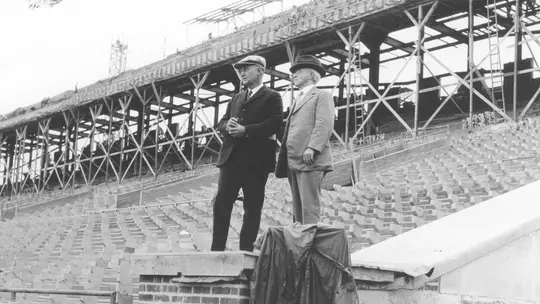
George Huff, one of Illinois’ first standout athletes, rose through the ranks and molded the lives of hundreds of other young men through his role as a Fighting Illini coach (1895-1919) and as the Illini’s longtime director of athletics (1901-1936).
Having witnessed hundreds of events at ancient Illinois Field and observing UI student enrollment growing at a rapid pace, Huff realized that the future development of his athletic program depended on the speedy construction of a new football stadium. Eastern schools like Harvard and Yale already had large stadiums in place, and sister institutions in the Big Ten had preceded Illinois in breaking ground for facilities.
“Illinois is larger and has more prestige than any of these universities,” Huff said, “yet we have a field with wooden bleachers.”
When Ohio State came to Champaign-Urbana in November of 1920 and an estimated 20,000 fans had to be turned away, that convinced Huff to pull the trigger on facility expansion.
University of Illinois President David Kinley enthusiastically supported Huff’s proposal for a stadium and encouraged Huff to assemble an executive committee of successful alumni businessmen and professionals. Campaign director W. Elmer Ekblaw and collection manager C. J. Rosebery knew that amassing such an accomplished group would be necessary to undertake the lofty $2.5 million capital campaign objective.
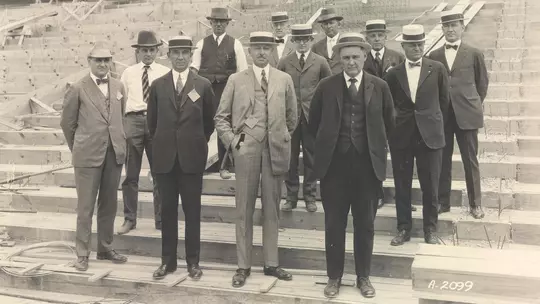
The fundraising campaign began on April 25, 1921, when Kinley, Huff, and head football coach Robert Zuppke addressed thousands of UI students at the gym annex. Local newspaper reporters told Champaign-Urbana readers about the scene, saying “it looked like the Chicago Coliseum during the Republican convention.”
“It was packed with men and women, seated in orderly rows. President Kinley spoke, giving dignity to the stadium idea. When G. Huff rose to speak, the din of cheering lasted very long.”
“I want to see a great stadium at the University of Illinois,” Huff said, “and I believe you will get it. I believe there is a great spirit at this university. The stadium will be many things: a memorial to the Illini who have died in the war, a recreation field for our students, and an imposing place for our varsity games. But, it will also be an unprecedented expression of Illinois spirit.”
Zuppke spoke next, asking the students for an initial pledge of $1,000. A handsome Brazilian student named Ruy de Lima Cavalcanti shouted, “I will give, sir.” Following a period of pandemonium, a flood of pledges ensued. Some seven days later, close to $665,000 in student pledges had been assured.
On Aug. 1, 1921, Huff and Zuppke set out on a historic jaunt through the Western United States to raise funds. After an initial alumni meeting in Los Angeles, stops in Salt Lake City, Denver, Omaha, and Rock Island followed. Enthusiasm for the project was overwhelming.
“Two million dollars? That’s a drop in the ocean as appreciation for what Illinois’ sons did for Illinois (during World War I),” said donor Orville Davis. “Build that stadium for the Fighting Illini.”
Ground was finally broken on Sept. 11, 1922, when George Huff turned up the first spadeful of earth in that 56-acre tract of prairie land.
“This stadium represents a series of three thoughts. The first is to recommend physical education to the students of the University. The second is its memorial feature, showing the sacrifice of Illini in the past. The third feature is that the students will build it with contributions from alumni and friends,” said University President Kinley to the 500 townsfolk who had gathered for the service. “Nothing could give me more pride than I have through being the leader of the faculty and students of the University of Illinois. I wish to pay tribute to G. Huff and the other men who have contributed so much to this success.”
The task of building the stadium – conceived and designed by Chicago architects Holabird and Roche – was awarded on Aug. 25, 1922, through open bid to English Brothers of Champaign. Almost immediately following the groundbreaking service, work began in earnest, optimistically aiming for an opening game in November of 1923.
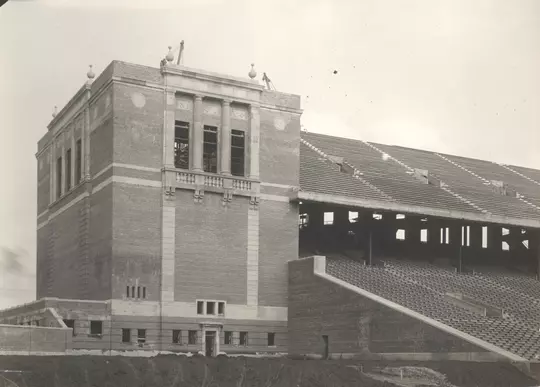
Officials estimated that the edifice would extend 1,000 feet long from north to south, 685 feet wide from east to west, and 115 feet high. Builders projected that construction would require 12 million pounds of cement, 20,000 yards of concrete, 35,000 tons of sand and gravel, 112,000 cubic feet of cut stone, five million bricks, 1,600 tons of reinforcing steel, and 1,600 tons of structural steel.
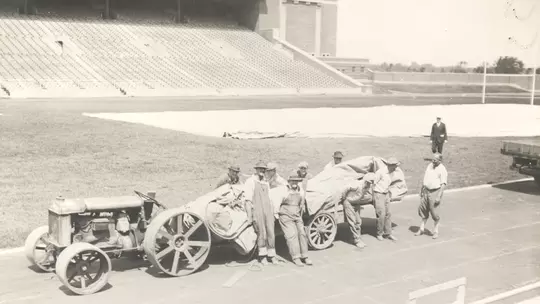
Some heavy machinery was used in the construction, including a steam shovel, several tractors, and a pair of massive cranes for moving and lifting. Steel-wheeled wagons, pulled by teams of work horses, were plentiful.
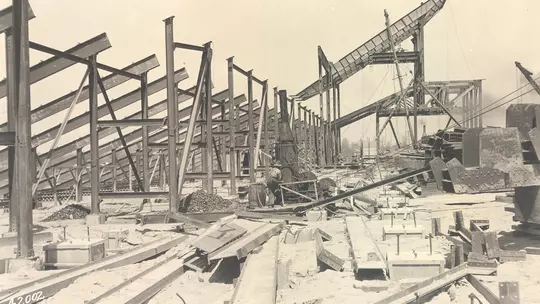
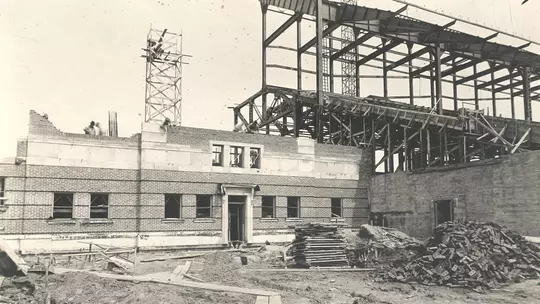
In early November of 1922, heavy rains forced a slight pause in construction, though Champaign newspapers reported that 200 men and a night shift of 25 more had completed a majority of the excavation and had begun putting up wall forms.
By mid-December, foundations had been completed. Contractors were ready to begin on structural steel work, but steel shipments arrived slowly.
When the calendar turned to 1923 in January, The Daily Illini reported that concrete foundations and walls of the stadium were practically finished.
In April of 1923, delinquent payments to stadium pledges threatened progress of the construction. Stadium business manager C. J. Rosebery begged the student body and alumni to meet their obligations.
“Stadium subscriptions are more than $100,000 short of the amount needed to adequately finance construction,” he said.
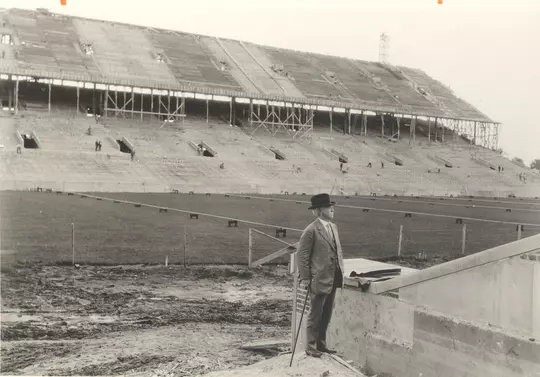
“No money, no work,” Huff said. “We cannot mortgage the future by going into debt to complete the stadium. I’d rather leave the half-erected girders sticking up in the air and let them show people their own significance, rather than load the project with an enormous debt.”
Rosebery and Huff’s pleas and intensive follow-up work by the stadium’s executive committee slowly gained traction and ultimately got a majority of the bills paid.
By late May of 1923, nearly 60 carpenters prepared concrete forms, and an additional 40 steel workers had placed most of the steel girders for the east and west balconies. In June, with the arrival of cut stone, work on the four towers began, as did pouring of concrete for the first 20 rows of seats. Tiling and sodding of the playing field were completed later in the month.
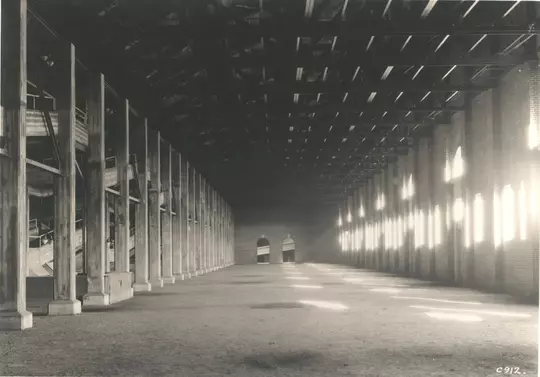
In July, shipment of cypress from Mississippi, Louisiana, and Florida for the miles of bench seats began to arrive. Additionally, cement work commenced on the winding series of ramps in the towers.
By August, with 300 men at work, about 20,000 of the seats had been poured. Come September, concrete for 37,000 seats was in the forms, but officials remained hopeful that they would be able to accommodate a crowd of 50,000 seats for the targeted Nov. 3 Homecoming game against Chicago.
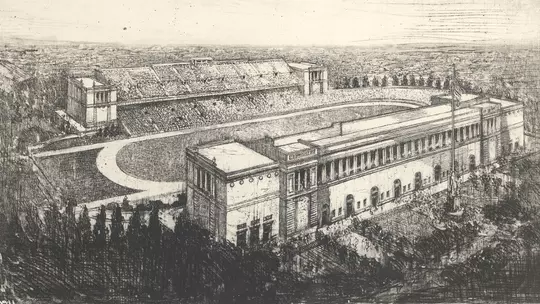
Finally, Memorial Stadium opened to the public, a mere 14 months after construction had initially begun. The stadium committee and contractors had won the greatest race in the University’s history.
Despite a steady rain leading up to the 2 p.m. kickoff, the final attendance for the Homecoming game against Chicago resulted in 60,632 tickets sold at $2.50 apiece.
The Daily Illini reported that attending spectators were thrilled by the events of Nov. 3.
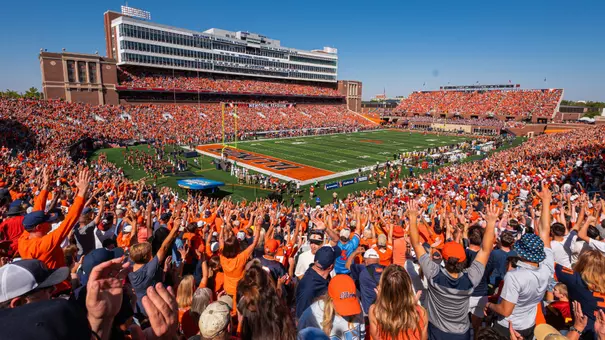
“The two great stands, banked on either side of the soaked gridiron, were filled from boxes to balconies with faces and all the colors known to campus life,” per the article. “The 60,000 faces were not turned toward the trains, nor toward the gray plane that sputtered back and forth overhead, not toward the lines of straggling late-comers that pushed and splashed their way through the mud to the ramp towers and climbed upward to seats in faraway rows.
“Down on the playing field, two thin lines—dark blue and dark red—swayed to and fro, mingling, clustering, fighting, breaking—Illinois and Chicago at death grips. Suddenly a blue clad figure (Red Grange) broke away and sped clear, toward the coveted goal. He was downed, but once the lines reformed that same blue runner dashed through and fell beyond the last white line. Grange had scored. Illinois had won its first Stadium game! A tremendous cheer rolled up from the bowl and swept out to the world. The Illini were happy!”