Memorial Stadium: 2010s-2020
5/21/2024
The Fighting Illini entered the 2010s with a new man under center, Nate Scheelhaase, and a plethora of experienced players looking to bring the program back to bowl eligibility. That is exactly what the Orange and Blue did.
Winners of four of their first five games played at Memorial Stadium, Illinois secured convincing margins of victory in each of those wins, emerging victorious by an average of 24.4 points.
“Convincing wins in front of your home crowd are what college football is all about,” Scheelhaase said when reflecting on those dominant home performances. “You could feel the support of campus, the alumni, and the Champaign-Urbana communities. To have those positive vibes after having some seasons where we didn't have success, you can feel the appreciation and the excitement. This was a team with no expectations, and people didn't think much of us. All of a sudden, we were doing things that people didn't really expect us to do. I think that was a cool part after not feeling that for the last couple of years before then.”
Going 4-2 in home games during the 2010 campaign, the Illini secured a win over Northwestern at Wrigley Field in their regular-season finale to capture a bowl berth, the program’s first since going to the Rose Bowl three years earlier. Earning a trip to the Texas Bowl, the Orange and Blue pulled off a dominant 38-14 victory against Baylor in hostile territory, which clinched the Illini’s first bowl win in over a decade.
The postseason triumph served as a boost of confidence and momentum heading into the 2011 season, which featured a string of five consecutive home games to start the year and a program-record of eight total home contests throughout the schedule.
That opening slate was a major talking point for the team during the spring and summer. Knowing they would have the upper hand early in the season, the Illini needed to take advantage of the unique opportunity.
“We talked about it all offseason,” Scheelhaase said. “Coach Zook was saying ‘Hey, if we can protect our home turf, we're, number one, gonna get off to a great start but, number two, we're gonna have a really successful season.’ Getting started at home, having some success, and knowing that we had two very winnable games to open up and had that third game circled as a big-time game against Arizona State at home, we wanted to get off to a great start and be able to prove what this team could ultimately be about. Obviously, at the very beginning of that, we did get off to that kind of a start.”
Starting the year with a 33-15 win over Arkansas State in the season opener before recording a 56-3 victory over South Dakota State, the Illini welcomed No. 22 Arizona State to Memorial Stadium in Week 3 for a night game under the lights.
Illinois jumped out to a quick 7-0 start after forcing a three-and-out and then taking advantage of good field position to find the end zone. The Sun Devils evened the score on their next drive
before the Illini pulled back in front via a field goal. After two quarters of scoreless football, Arizona State took its first lead of the night on a touchdown, but Illinois did not trail for long.
A strip sack from Whitney Mercilus set up the Orange and Blue offense deep in opposing territory, and the Illini needed only four plays to get back in the end zone and go in front once again, taking a 17-14 advantage that they held the rest of the way. The victory marked the team’s first home win over a ranked opponent since 2007.
“That was an incredible, electrifying night game,” Mercilus said. “During my time at Illinois, I didn't experience anything else like it. It was just amazing, especially to pull out that win. It was definitely hot and a little bit humid, but the atmosphere that night sticks into my mind as far as what Illinois football is and should always be.”
Entering the AP rankings for the first time since 2008, the No. 24-ranked Illini continued their home reign of terror with wins over Western Michigan (27-24) and Northwestern (38-35). The triumph over the Wildcats featured a last-minute comeback after the visitors took a 35-31 lead with 1:15 remaining. Driving 69 yards on six plays, Illinois – which trailed by as many as 18 in the second half and completed its largest comeback in six years – extended its winning streak to open the 2011 campaign to five games, its best start to a season in six decades.
One week later, the Illini clinched a bowl berth in their first road game of the season, marking back-to-back trips to the postseason for the first time since the 1991-92 campaigns. Though the Illini fell in their final three home games of the year, two of which came at the hands of ranked opposition, they won the Kraft Fight Hunger Bowl with a 20-14 victory over UCLA. The win marked back-to-back bowl triumphs for the first time in program history.
Drawing in the sixth-highest single-season home attendance in Memorial Stadium history, the Illini created a significant home-field advantage that led to the program picking up nine wins in Champaign across the 2010 and 2011 campaigns.
“Any time you have a successful program, people want to come and see a winner,” said Ron Zook, who served at the helm of Illinois football from 2005-11. “Whenever you talk about home- field advantage, the home-field advantage is caused by the crowds. The people make places tough to play in. It's the fans. It's the people who are proud of their program. It’s what makes Memorial Stadium a special place. I always enjoyed coming out and playing, particularly when we had big crowds. You look at Memorial Stadium, you look at the history, you look at some of the people who have coached and played there: It's a pretty unique place.”
After Illinois spent three seasons under the guidance of Tim Beckman, whose tenure was highlighted by an appearance in the 2014 Zaxby’s Heart of Dallas Bowl, and a year with Bill Cubit serving as the interim head coach in 2015, athletic director Josh Whitman reinvigorated the program with the hiring of Lovie Smith. With nearly two decades of NFL experience, Smith became the first Black head football coach in program history.
Linebacker Jake Hansen – who also joined the program ahead of the 2016 campaign and went on to play under the former Illini head coach with the Houston Texans – immediately clicked with Smith and knew the new man at the helm would add a big boost for the Fighting Illini football program.
“My first impressions of him were great,” Hansen said. “Once I got here, I realized he was a great leader of men, a great man overall, and someone who I could learn a lot from. We built a strong relationship. We still talk to this day, and I don't see that changing for a really long time. It was great being able to meet him, learn from such a great football mind, and eventually get someone who is like family to me now. I owe a lot of my career to him, and I can truly say that I would not be here in the NFL today if it wasn't for Lovie Smith.”
The excitement surrounding Smith’s signing led to the Illini attracting a sell-out crowd against North Carolina in his second game with the program, the largest home crowd in nearly five years. Bringing in nearly 320,000 fans across the team’s seven home games in 2016, Illinois secured its largest single-season attendance mark since the 2011 campaign.
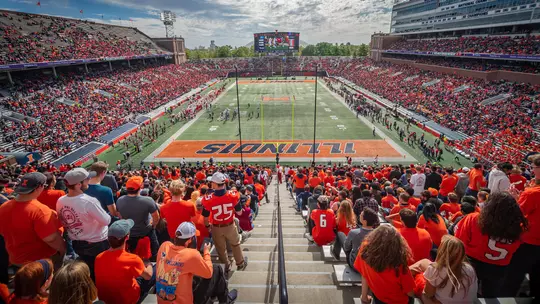
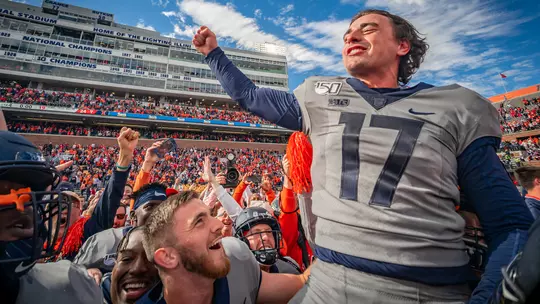
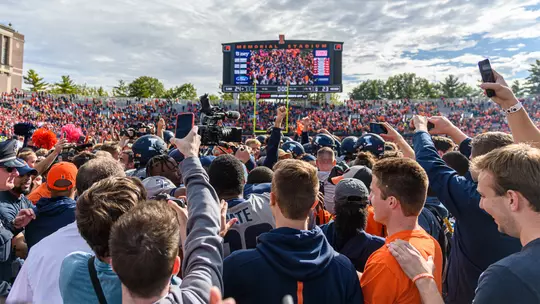
Going 4-0 in non-conference home games across the 2017 and 2018 seasons, the Orange and Blue went into 2019 looking to right the ship and return to the postseason. Though the team started the year with a dominant 42-3 win over Akron, Illinois sat at 2-4 at the halfway point of the regular season ahead of a meeting with unbeaten No. 6 Wisconsin next on the schedule.
Massive underdogs heading into the Homecoming contest at Memorial Stadium, the Illini knew the odds were stacked against them.
“Games like that, you go out there with nothing to lose,” said starting defensive back Tony Adams, who has gone on to play in the NFL. “Everybody in the world thought we were gonna lose, but as long as we believed in each other and we went out there and executed, we always had a chance.”
One of five team captains that season, Hansen kept the squad even-keeled and level-headed going into the game. Knowing they would need to put together a near-perfect performance to knock off the Badgers, the Illini never wavered.
“You always prepare like you're going to win the game, and your coaches give you the best game plan to go in and win the game,” Hansen said. “We were coming off a big loss, and we were very frustrated and hungry to beat someone and win a game. It ended up being a perfect storm for us.”
Wisconsin jumped out to a 10-0 lead before Illinois got on the board via a 48-yard touchdown with six minutes remaining in the first half. That deficit doubled in size prior to halftime, and the Illini went into the locker room trailing by six points, 13-7.
Early in the third quarter, Wisconsin went in front by two scores, 20-7, but Illinois did not falter. A touchdown late in the frame cut into the home side’s deficit before a Badger field goal put the
Illini down by two possessions once again. The Orange and Blue offense had a turnover on downs, but a forced fumble by Hansen in the red zone on the Badgers’ next drive put the Illini back in business.
Needing only 79 seconds to find the end zone, the Illini were right back in the game, 23-21, heading into the final six minutes of the contest. A timely interception from Adams brought the offense back on the field with 2:32 to play, and the rest is history.
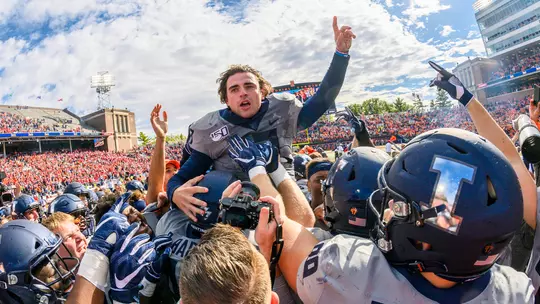
A 39-yard field goal off the right foot of James McCourt as time expired sent Memorial Stadium into delirium, giving Illinois a signature come-from-behind 24-23 upset win.
“I was kneeling down looking back toward the student section. I could see it was through the uprights, we got the signal that it was good, and it was just chaos,” said Hansen, who recorded 11 tackles, two forced fumbles, and one sack in the game. “I had a smile on my face for the rest of the night and probably a few days after that. It was really cool to see everyone’s reactions: from the fans, to the students, to the team. To be a major factor in the game and affect the game in a major way, that was a really cool moment.”
For Adams, whose interception led to the game-winning drive, the win was extra special. After feeling bummed about switching from safety to corner ahead of the contest, Adams came through in the biggest moment and was a huge factor behind the Illini pulling off the walk-off win and their first victory over a ranked opponent since 2011.
“I remember my mom told me before the game, ‘Quit crying; just go do it. It doesn't matter where they move you. As long as you're on the field, you have an opportunity.’ Earlier that week, she actually texted me and was like, ‘I had a dream that you're gonna get a game- winning interception this week.’ It was kind of crazy,” Adams said. “When the kick went in, the first person I went up to was my mama. I hugged her and cried in her arms because it finally felt like a turning point in my career. All the dark times and all the dark days, I finally felt like I was getting over the hump a little bit, especially with that play. I didn't really care about anybody else on that field except for going to see my mom. It was a special moment.”
The victory kickstarted a four-game winning streak for the Illini – which featured a 24-6 win over Purdue to reclaim The Cannon trophy, a dominant home win over Rutgers on Dads Weekend, and a 37-34 victory over Michigan State away from home in the largest comeback in program history – to secure bowl eligibility for the first time in five seasons.
It is hard to dispute that the Wisconsin win was a turning point in the campaign. With a majority of the roster making their postseason debuts, the triumph over the Badgers turned the tides and changed the course of the season.
“We knew we were good enough. We went on a run because of the simple fact that we started
to believe in ourselves. We started to play with that confidence of knowing that we were good
enough,” Adams said. “It meant everything to make a bowl game because it was like we were
finally getting over the hump.”
Though the Illini fell to Cal in the Redbox Bowl, the postseason berth served as a source of motivation moving forward and sent the Illinois football program into the 2020s with momentum. A bowl win was not in the cards to close an up-and-down decade, but two bowl wins earlier in the 2010s marked growth and improvement heading into a new era for the program ahead of an unprecedented 2020 campaign.
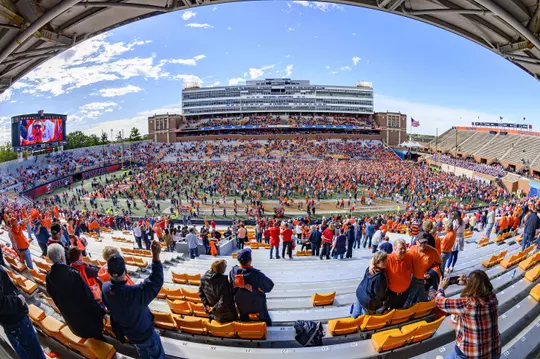
The turn of the decade started with a season that was nothing short of unheard of and historic. After COVID-19 brought the world to a halt in March of 2020, the widespread effects of the pandemic also impacted the college football world.
The Big Ten announced in mid-August that it would be postponing all fall sports, including football, and eliminating non-conference contests. As a result, Illinois opened its 2020 campaign two months later than previously anticipated in a conference-only, abbreviated schedule.
Playing in near-empty stadiums that included small crowds of working personnel and families of players and staff, the Illini underwent daily antigen testing while practicing social distancing and other COVID-19 protocols. Illinois began its shortened slate on Oct. 24, 2020, in the latest start to a season in the program’s history.
“It was really weird. Games felt more like scrimmages because the fans mean so much to the game. To not have them there, it really sucked,” said former Illini defensive back and current New York Jets safety Tony Adams. “Our coaches did a great job of keeping us orchestrated and organized. It was just a weird season. Some people were playing and other people weren't. It was just a weird season altogether.”
Across the team’s three home contests, the Illini announced a combined attendance of 2,576 for an average of 859 fans per game. Playing only eight times that year, Illinois battled through injuries and absences due to cases of COVID-19 within the program.
“I feel like stuff like that is where you grow. Smooth seas don’t make a good sailor,” Adams said. “You have to go through those hard times. We weren't the only ones going through it. We learned how to be resilient and persevere. To know that the whole world was going through it made it a little bit easier.”
Memorial Stadium Score - 2010-2020
| Date | (Ill. Rank) Opponent (Opp. Rank) | Score | W/L | Attendance |
| Sept. 11, 2010 | Southern Illinois | 35-3 | W | 52.217 |
| Sept. 18, 2010 | Northern Illinois | 28-22 | W | 50,569 |
| Oct. 2, 2010 | Ohio State (2) | 13-24 | L | 62,870 |
| Oct. 23, 2010 | Indiana | 43-13 | W | 53,550 |
| Oct. 30, 2010 | Purdue | 44-10 | W | 50,371 |
| Nov. 13, 2010 | Minnesota | 34-38 | L | 55,549 |
| Sept. 3, 2011 | Arkansas State | 33-15 | W | 45,154 |
| Sept. 10, 2011 | South Dakota State | 56-3 | W | 42,212 |
| Sept. 17, 2011 | Arizona State (22) | 17-14 | W | 50,669 |
| Sept. 24, 2011 | (24) Western Michigan | 23-20 | W | 43,684 |
| Oct. 1, 2011 | (24) Northwestern | 38-35 | W | 43,243 |
| Oct. 15, 2011 | (16) Ohio State | 7-17 | L | 55,229 |
| Nov. 12, 2011 | Michigan (22) | 14-31 | L | 60,670 |
| Nov. 19, 2011 | Wisconsin (15) | 17-28 | L | 45,519 |
| Sept. 1, 2012 | Western Michigan | 24-7 | W | 43,441 |
| Sept. 15, 2012 | Charleston Southern | 44-0 | W | 45,369 |
| Sept. 22, 2012 | Louisiana Tech | 24-52 | L | 46,539 |
| Sept. 29, 2012 | Penn State | 7-35 | L | 46,734 |
| Oct. 27, 2012 | Indiana | 17-31 | L | 47,981 |
| Nov. 10, 2012 | Minnesota | 3-17 | L | 46,912 |
| Nov. 17, 2012 | Purdue | 17-20 | L | 41,974 |
| Aug. 31, 2013 | Southern Illinois | 42-34 | W | 42,175 |
| Sept. 7, 2013 | Cincinnati | 45-17 | W | 43,031 |
| Sept. 28, 2013 | Miami (Ohio) | 50-14 | W | 46,890 |
| Oct. 19, 2013 | Wisconsin (25) | 32-56 | L | 47,362 |
| Oct. 26, 2013 | Michigan State | 3-42 | L | 45,895 |
| Nov. 16, 2013 | Ohio State (3) | 35-60 | L | 44,095 |
| Nov. 30, 2013 | Northwestern | 34-37 | L | 37,058 |
| Aug. 30, 2014 | Youngstown State | 28-17 | W | 36,234 |
| Sept. 6, 2014 | Western Kentucky | 42-34 | W | 38,561 |
| Sept. 20, 2014 | Texas State | 42-35 | W | 41,019 |
| Oct. 4, 2014 | Purdue | 27-38 | L | 45,046 |
| Oct. 25, 2014 | Minnesota | 28-24 | W | 44,437 |
| Nov. 15, 2014 | Iowa | 14-30 | L | 50,373 |
| Nov. 22, 2014 | Penn State | 16-14 | W | 35,172 |
| Sept. 5, 2015 | Kent State | 52-3 | W | 36,693 |
| Sept. 12, 2015 | Western Illinois | 44-0 | W | 37,733 |
| Sept. 26, 2015 | Middle Tennessee | 27-25 | W | 44,366 |
| Oct. 3, 2015 | Nebraska | 14-13 | W | 40,138 |
| Oct. 24, 2015 | Wisconsin | 13-24 | L | 45,438 |
| Nov. 14, 2015 | Ohio State (2) | 3-28 | L | 51,515 |
| Sept. 3, 2016 | Murray State | 52-3 | W | 48,644 |
| Sept. 10, 2016 | North Carolina | 23-48 | L | 60,670 |
| Sept. 17, 2016 | Western Michigan | 10-34 | L | 40,954 |
| Oct. 8, 2016 | Purdue | 31-34 | L (OT) | 42,912 |
| Oct. 29, 2016 | Minnesota | 17-40 | L | 40,090 |
| Nov. 5, 2016 | Michigan State | 31-27 | W | 47,144 |
| Nov. 19, 2016 | Iowa | 0-28 | L | 39,091 |
| Sept. 2, 2017 | Ball State | 24-21 | W | 42,505 |
| Sept. 9, 2017 | Western Kentucky | 20-7 | W | 41,923 |
| Sept. 29, 2017 | Nebraska | 6-28 | L | 43,058 |
| Oct. 14, 2017 | Rutgers | 24-35 | L | 35,765 |
| Oct. 28, 2017 | Wisconsin (5) | 10-24 | L | 42,101 |
| Nov. 11, 2017 | Indiana | 14-24 | L | 40,195 |
| Nov. 25, 2017 | Northwestern (22) | 7-42 | L | 30,456 |
| Sept. 1, 2018 | Kent State | 31-24 | W | 31,898 |
| Sept. 8, 2018 | Western Illinois | 34-14 | W | 39,252 |
| Sept. 21, 2018 | Penn State (10) | 24-63 | L | 34,704 |
| Oct. 13, 2018 | Purdue | 7-46 | L | 41,966 |
| Nov. 3, 2018 | Minnesota | 55-31 | W | 35,774 |
| Nov. 17, 2018 | Iowa | 0-63 | L | 33,313 |
| Aug. 31, 2019 | Akron | 42-3 | W | 30,654 |
| Sept. 14, 2019 | Eastern Michigan | 31-34 | L | 34,759 |
| Sept. 21, 2019 | Nebraska | 38-42 | L | 44,512 |
| Oct. 12, 2019 | Michigan (16) | 25-42 | L | 37,275 |
| Oct. 19, 2019 | Wisconsin (6) | 24-23 | W | 37,363 |
| Nov. 2, 2019 | Rutgers | 38-10 | W | 35,652 |
| Nov. 30, 2019 | Northwestern | 10-29 | L | 35,895 |
| Oct. 31, 2020 | Purdue | 24-31 | L | 838 COVID |
| Nov. 7, 2020 | Minnesota | 14-41 | L | 863 COVID |
| Dec. 5, 2020 | Iowa (19) | 21-35 | L | 875 COVID |