Memorial Stadium: 1970s-1980s
5/21/2024
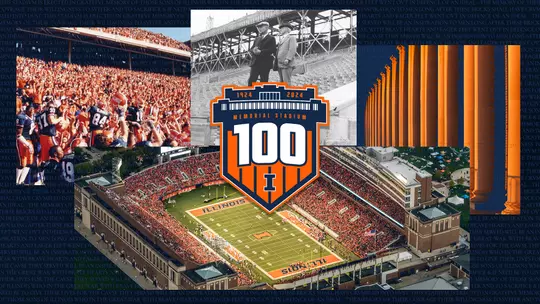
In many ways, the decades of the 1970s and the 1980s for University of Illinois football were diametrically opposite of each other.
Coming off the slush fund controversy of 1966 and ’67, Fighting Illini football entered the 1970s with a whimper. Coach Jim Valek’s four Illinois teams won only five of its 28 conference games, and new UI athletic director Cecil Coleman surprised the so-called experts by replacing Valek in 1971 with Bob Blackman, a coach with impressive credentials from the Ivy League.
“I knew all about the great legends of Illinois – Bob Zuppke , Red Grange, and all – and I’d watched Buddy Young play on the West Coast when I was in the Navy,” Blackman said. “Since I’d spent most of the first six years of my life in Illinois and Chicago before my family moved to the Los Angeles area, I felt like coaching at Illinois would sort of be like going back home. Even the name ‘Fighting Illini’ was something that always intrigued me.”
It did not start well for Blackman during that debut season, losing his first six games in 1971. Fortunately, five consecutive victories in the second half of the campaign gave Blackman some momentum going into the recruiting season. Among the impressive players who he talked into attending Illinois were future all-stars Scott Studwell, John Sullivan, Tom Hicks and Stu Levenick.
Unfortunately, for 80% of the conference, this period was when the Big Ten was known as the Big Two (Ohio State and Michigan) and the Little Eight. Actually, Blackman’s six Illini teams from 1971-76 were considerably more competitive in conference play, but a combined 0-12 record against the Buckeyes and Wolverines overshadowed his 24-11-1 mark against the other seven Big Ten teams.
Coleman fired Blackman following the ’76 season and hired Bo Schembechler assistant Gary Moeller from Michigan. A 6-24-2 record in three seasons proved to be a disaster, and both Coleman and Moeller lost their jobs.
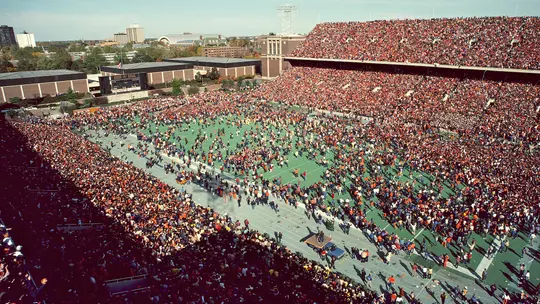
Illinois’ athletic department took a bold step by replacing those men with Californians Neale Stoner and Mike White and optimistically proclaimed – even before the first football game was played – that “the ‘80s belong to the Illini.”
The 1980 campaign (3-7-1) did not live up to that prediction, but there were significant indications that times were changing. Heading the positivity trend was an NCAA record 621-yard passing performance by Illini quarterback Dave Wilson at Ohio State.
The recruiting efforts of White and his staff began to pay big dividends shortly afterwards. A 7-4 record in 1981 was Illinois’ best record in 18 years. An identical 7-4 regular-season mark in ’82 earned the Illini a berth in the Liberty Bowl, the program’s first postseason game since the ’64 Rose Bowl.
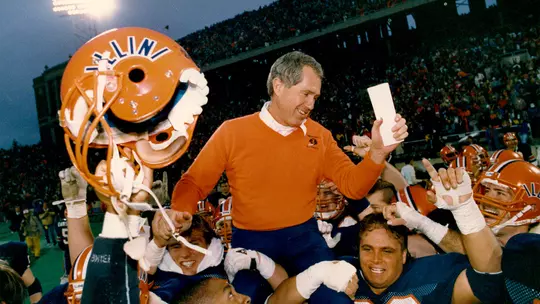
But, the most impressive of White’s eight Illini teams came in 1983. Though Illinois fell at Missouri in the opener, the Illini finished the regular season with 10 consecutive wins, including a perfect 9-0 record against Big Ten competition. It was the first time in league history that a team had beaten all nine conference schools in the same season.
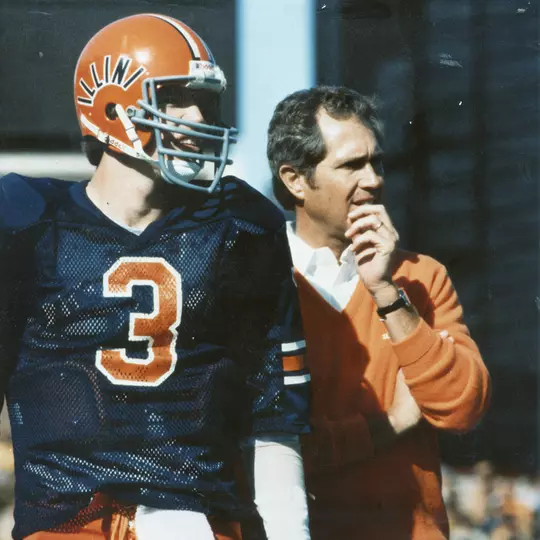
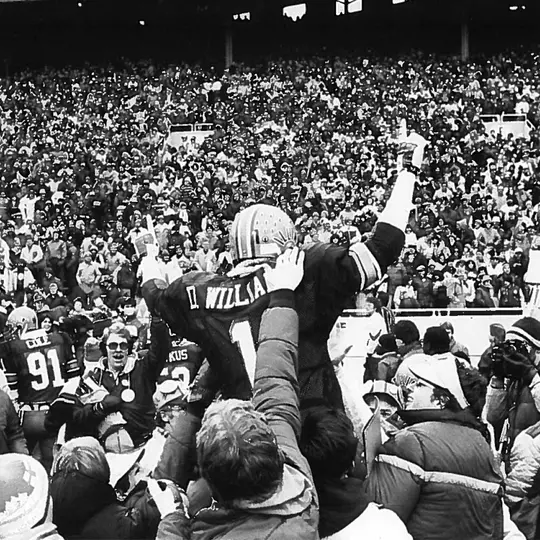
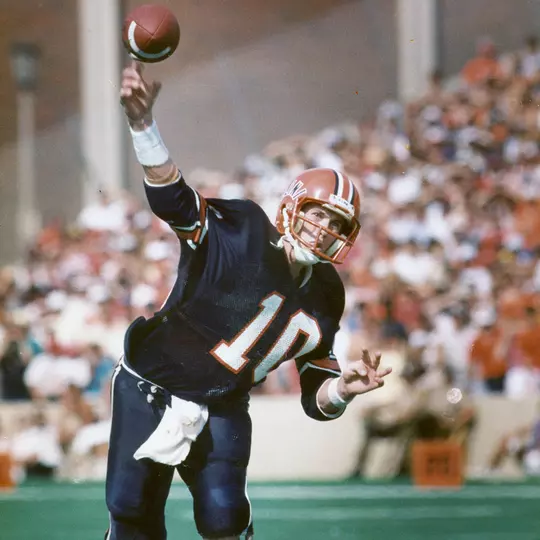
White’s offensive stars included quarterback Jack Trudeau, running back Thomas Rooks, wide receiver David Williams, and lineman Jim Juriga. The defense boasted such stalwarts as ‘83 Big Ten MVP Don Thorp, Mark Butkus, and Craig Swoope.
The campaign ended on a down note with a loss at the Rose Bowl against UCLA.
Memorial Stadium burst at the seams during much of the Mike White era. Season-ticket sales grew from 12,000 in 1979 to a point where sales were cut off at 50,000 in 1983. Altogether, from Sept. 25, 1982, through Sept. 12, 1987, there were 28 consecutive sellouts.
Illinois football had winning records in 1984 and ’85, but White’s well of success dried up for his last two seasons, and Stoner replaced him as head coach with former Kansas City Chiefs coach John Mackovic.
Inheriting many of White’s players and adding several of his own recruits, Mackovic’s first team in 1988 qualified for the All-American Bowl. His second squad, in 1989, began the year with a come-from-behind win at Southern California on Labor Day night, then was embarrassed at Colorado. After that, Illinois won nine of its last 10, including a victory over Virginia in the Florida Citrus Bowl. They wound up 10th in the final national rankings.
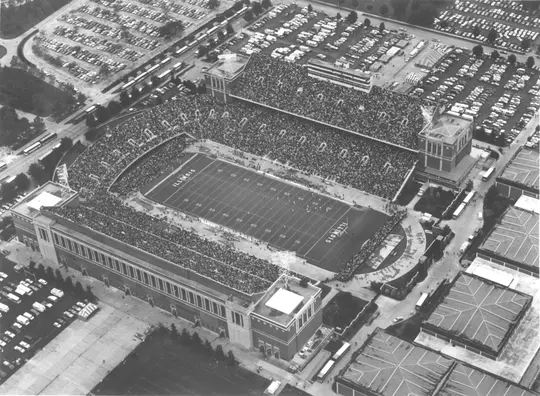
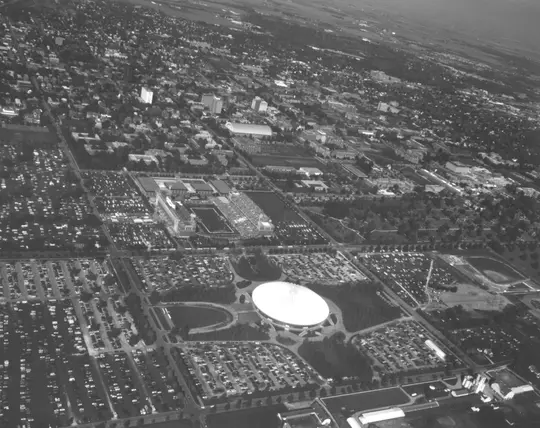
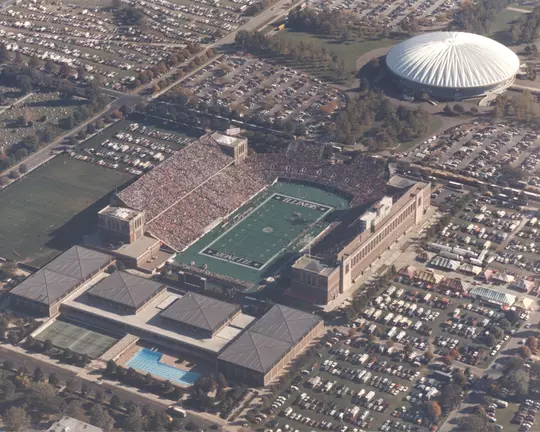
Memorial Stadium Scores - 1971-1989
| Date | (Ill. Rank) Opponent (Opp. Rank) | Score | W/L | Attendance |
| Sept. 19, 1970 | Oregon | 20-16 | W | 33,246 |
| Sept. 26, 1970 | Tulane | 9-23 | L | 27,864 |
| Oct. 3, 1970 | Syracuse | 27-0 | W | 39,357 |
| Oct. 17, 1970 | Indiana | 24-30 | L | 42,079 |
| Oct. 24, 1970 | Ohio State (1) | 29-48 | L | 46,208 |
| Nov. 14, 1970 | Wisconsin | 17-29 | L | 36,569 |
| Sept. 18, 1971 | North Carolina | 0-27 | L | 49,391 |
| Oct. 2, 1971 | Washington (15) | 14-52 | L | 48,127 |
| Oct. 9, 1971 | Ohio State (15) | 10-24 | L | 53,555 |
| Oct. 23, 1971 | Purdue (17) | 21-7 | W | 52,344 |
| Oct. 30, 1971 | Northwestern | 24-7 | W | 40,144 |
| Nov. 20, 1971 | Iowa | 31-0 | W | 40,703 |
| Sept. 16, 1972 | Michigan State | 0-24 | L | 55,493 |
| Sept. 23, 1972 | USC (1) | 20-55 | L | 61,225 |
| Oct. 7, 1972 | Penn State (16) | 17-35 | L | 60,394 |
| Oct. 21, 1972 | Michigan (6) | 7-31 | L | 64,290 |
| Nov. 11, 1972 | Indiana | 37-20 | W | 55,077 |
| Nov. 18, 1972 | Wisconsin | 27-7 | W | 45,703 |
| Sept. 29, 1973 | West Virginia | 10-17 | L | 48,107 |
| Oct. 6, 1973 | Stanford | 0-24 | L | 45,383 |
| Oct. 13, 1973 | Purdue | 15-13 | W | 54,252 |
| Oct. 27, 1973 | Iowa | 50-0 | W | 48,864 |
| Nov. 3, 1973 | Ohio State (1) | 0-30 | L | 60,707 |
| Nov. 17, 1973 | Minnesota | 16-19 | L | 34,438 |
| Sept. 14, 1974 | Indiana | 16-0 | W | 40,911 |
| Sept. 28, 1974 | (16) Washington State | 21-19 | W | 40,594 |
| Oct. 5, 1974 | (14) California | 14-31 | L | 54,378 |
| Oct. 19, 1974 | Michigan State Golden Anniversary | 21-21 | T | 55,677 |
| Nov. 9, 1974 | Michigan (4) | 6-14 | L | 60,670 |
| Sept. 20, 1975 | Missouri (5) | 20-30 | L | 57,059 |
| Oct. 4, 1975 | Washington State | 27-21 | W | 51,060 |
| Oct. 11, 1975 | Minnesota | 42-23 | W | 46,162 |
| Oct. 18, 1975 | Purdue | 24-26 | L | 61,204 |
| Nov. 8, 1975 | Ohio State (1) | 3-40 | L | 67,571 |
| Nov. 15, 1975 | Michigan (4) | 15-21 | L | 45,077 |
| Sept. 11, 1976 | Iowa | 24-6 | W | 49,515 |
| Sept. 25, 1976 | (14) Baylor | 19-34 | L | 44,481 |
| Oct. 2, 1976 | Texas A&M (9) | 7-14 | L | 67,543 |
| Oct. 23, 1976 | Michigan State | 23-31 | L | 52,860 |
| Oct. 30, 1976 | Wisconsin | 31-25 | W | 54,121 |
| Nov. 20, 1976 | Northwestern | 48-6 | W | 34,500 |
| Sept. 10, 1977 | Michigan (2) | 9-37 | L | 60,477 |
| Sept. 17, 1977 | Missouri | 11-7 | W | 52,771 |
| Oct. 1, 1977 | Syracuse | 20-30 | L | 52,015 |
| Oct. 22, 1977 | Indiana | 21-7 | W | 50,298 |
| Nov. 5, 1977 | Ohio State (4) | 0-35 | L | 66,973 |
| Nov. 12, 1977 | Minnesota | 0-21 | L | 37,697 |
| Sept. 9, 1978 | Northwestern | 0-0 | T | 40,091 |
| Sept. 23, 1978 | Stanford | 10-35 | L | 43,143 |
| Oct. 14, 1978 | Wisconsin | 20-20 | T | 51,160 |
| Oct. 21, 1978 | Purdue (19) | 0-13 | L | 50,918 |
| Nov. 4, 1978 | Michigan State (18) | 19-59 | L | 48,077 |
| Sept. 15, 1979 | Missouri (11) | 6-14 | L | 66,306 |
| Sept. 29, 1979 | Navy | 12-13 | L | 53,825 |
| Oct. 6, 1979 | Iowa | 7-13 | L | 51,044 |
| Oct. 20, 1979 | Michigan (11) | 7-27 | L | 43,370 |
| Nov. 3, 1979 | Ohio State (5) | 7-44 | L | 41,870 |
| Nov. 10, 1979 | Indiana | 14-45 | L | 30,874 |
| Sept. 6, 1980 | Northwestern | 35-9 | W | 44,222 |
| Sept. 13, 1980 | Michigan State | 20-17 | W | 46,377 |
| Sept. 27, 1980 | Air Force | 20-20 | T | 45,638 |
| Oct. 4, 1980 | Mississippi State | 21-28 | L | 60,889 |
| Oct. 18, 1980 | Purdue | 20-45 | L | 62,121 |
| Nov. 1, 1980 | Minnesota | 18-21 | L | 51,202 |
| Sept. 19, 1981 | Syracuse | 17-14 | W | 57,579 |
| Oct. 3, 1981 | Minnesota | 38-29 | W | 63,814 |
| Oct. 24, 1981 | Wisconsin | 23-21 | W | 67,413 |
| Oct. 31, 1981 | Iowa (16) | 24-7 | W | 66,877 |
| Nov. 14, 1981 | Indiana | 35-14 | W | 56,143 |
| Sept. 4, 1982 | Northwestern First night game | 49-13 | W | 67,036 |
| Sept. 11, 1982 | Michigan State | 23-16 | W | 66,152 |
| Sept. 25, 1982 | (19) Pittsburgh (3) | 3-20 | L | 71,547 |
| Oct. 9, 1982 | (20) Purdue | 38-34 | W | 71,232 |
| Oct. 16, 1982 | (15) Ohio State | 21-26 | L | 73,488 |
| Nov. 6, 1982 | Michigan (15) | 10-16 | L | 75,256 |
| Sept. 17, 1983 | Stanford | 17-7 | W | 72,852 |
| Oct. 1, 1983 | Iowa (4) | 33-0 | W | 73,351 |
| Oct. 15, 1983 | (19) Ohio State (6) | 17-13 | W | 73,414 |
| Oct. 29, 1983 | (9) Michigan (8) | 16-6 | W | 76,127 |
| Nov. 12, 1983 | (5) Indiana | 49-21 | W | 73,612 |
| Sept. 1, 1984 | Northwestern | 24-16 | W | 75,753 |
| Sept. 8, 1984 | Missouri Largest crowd | 30-24 | W | 78,297 |
| Sept. 22, 1984 | Michigan State | 40-7 | W | 75,762 |
| Oct. 6, 1984 | Wisconsin | 22-6 | W | 76,428 |
| Oct. 20, 1984 | Purdue | 34-20 | W | 76,101 |
| Nov. 3, 1984 | Minnesota | 48-3 | W | 76,056 |
| Sept. 7, 1985 | (11) USC (6) | 10-20 | L | 76,369 |
| Sept. 14, 1985 | (19) Southern Illinois | 28-25 | W | 76,330 |
| Oct.5, 1985 | Ohio State (5) | 31-28 | W | 76,343 |
| Oct. 26, 1985 | Wisconsin | 38-25 | W | 76,395 |
| Nov. 2, 1985 | Michigan (4) | 3-3 | T | 76,397 |
| Nov. 16, 1985 | Indiana | 41-24 | W | 75,805 |
| Sept. 6, 1986 | Louisville | 23-0 | W | 72,822 |
| Sept. 20, 1986 | Nebraska (6) | 14-59 | L | 75,869 |
| Oct. 11, 1986 | Purdue | 34-27 | W | 73,720 |
| Oct. 18, 1986 | Michigan State | 21-29 | L | 75,083 |
| Nov. 8, 1986 | Iowa (16) | 20-16 | W | 75,190 |
| Nov. 22, 1986 | Northwestern | 18-23 | L | 70,568 |
| Sept. 12, 1987 | Arizona State (15) | 7-21 | L | 70,060 |
| Sept. 19, 1987 | East Carolina | 20-10 | W | 62,045 |
| Oct. 3, 1987 | Ohio State (9) | 6-10 | L | 73,045 |
| Oct. 17, 1987 | Wisconsin | 16-14 | W | 57,040 |
| Oct. 31, 1987 | Minnesota | 27-17 | W | 60,143 |
| Nov. 14, 1987 | Michigan | 14-17 | L | 64,496 |
| Sept. 3, 1988 | Washington State | 7-44 | L | 54,458 |
| Sept. 17, 1988 | Utah | 35-24 | W | 54,002 |
| Oct. 8, 1988 | Purdue | 20-0 | W | 63,473 |
| Oct. 22, 1988 | Michigan State | 21-28 | L | 65,771 |
| Nov. 5, 1988 | Indiana (20) | 21-20 | W | 66,201 |
| Nov. 19, 1988 | Northwestern | 14-9 | W | 43,329 |
| Sept. 23, 1989 | (20) Utah State | 41-2 | W | 61,553 |
| Oct. 7, 1989 | (18) Ohio State | 34-14 | W | 69,088 |
| Oct. 28, 1989 | (8) Wisconsin | 32-9 | W | 64,856 |
| Nov. 11, 1989 | (8) Michigan (3) | 10-24 | L | 73,069 |
| Nov. 18, 1989 | (12) Indiana | 41-28 | W | 53,368 |