5/21/2024
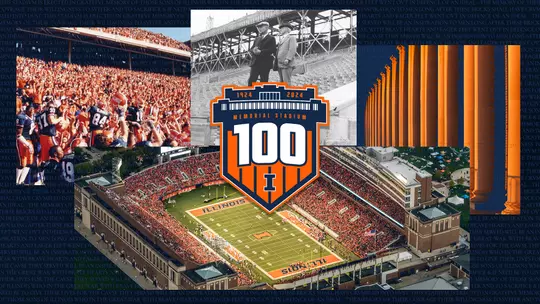
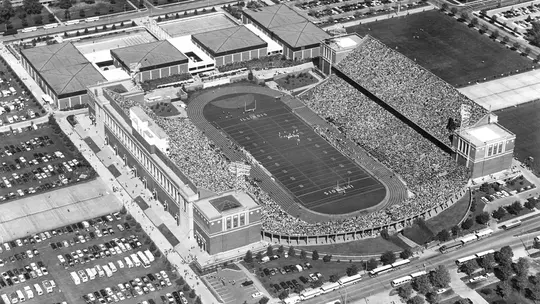
Memorial Stadium was the home of several Fighting Illini football stars during the 1950s and ‘60s.
After capturing the 1947 Rose Bowl title, Coach Ray Eliot’s teams admittedly finished the decade with mediocrity. Recruiting success, particularly on the defensive side of the ball and at quarterback and running back, helped the Illini surge in 1950. A one-point loss to Wisconsin in game two was followed by six consecutive victories. In five of those six contests, Illinois’ defense held their opponents to seven points or less, allowing the Illini to rise to a No. 6 national ranking. The season, however, ended disappointedly, losing by a touchdown at Northwestern and costing Illinois its second trip to the Rose Bowl in four years.
That winter, Eliot’s troops vowed to erase that frustrating memory. The offense got a gigantic boost when quarterback Tommy O’Connell transferred from Notre Dame to Illinois. His addition to running backs Bill Tate and Johnny Karras proved to be magical.
“Tommy gave our offense the passing dimension that we badly needed,” said teammate Sam Rebecca. “He opened up the game for us.”
The ’51 Illini opened impressively, coursing to No. 2 in the national rankings. While Karras was running around and over the opposition, defensive back Al Brosky seemed to intercept nearly every pass thrown his way. At one juncture, Brosky posted at least one defensive interception in 15 consecutive games and ended his career with a total of 29 picks.
Illinois’ sixth victory in an eventual streak of seven pitted the nation’s third-ranked team against No. 15 Michigan at Memorial Stadium. A sellout crowd of 71,119 shivering fans sat through a November snowstorm and a 40-mile-per-hour wind to watch the Illini and the Wolverines battle. They had to wait until four minutes remained in the fourth quarter to see Illinois’ spectacular 83-yard, game-winning drive into the teeth of the wind, climaxed by a pass from O’Connell to Rex Smith.
A 0-0 tie at Ohio State in game eight temporarily stalled the Illini, but they rebounded with a 3-0 triumph at Northwestern and clinched their second Big Ten title and second Rose Bowl berth in six seasons. A convincing 40-7 win over Stanford in Pasadena lifted Illinois to the 1951 national championship.
Illinois repeated as co-conference champs in 1953 with Michigan State, but Big Ten athletic directors chose instead to send the Spartans to the Rose Bowl. J. C. Caroline, Jan Smid, Mel Bates, Bob Lenzini, and Rocky Ryan all had all-star seasons for the Illini.
Despite have stars such as Bobby Mitchell, Ray Nitschke, Abe Woodson, and Bill Burrell on his roster, most of Eliot’s final six seasons floated around the .500 mark. He stepped down at the conclusion of the ’59 season and handed the reins to Bloomington, Ill., native and former Michigan star Pete Elliott.
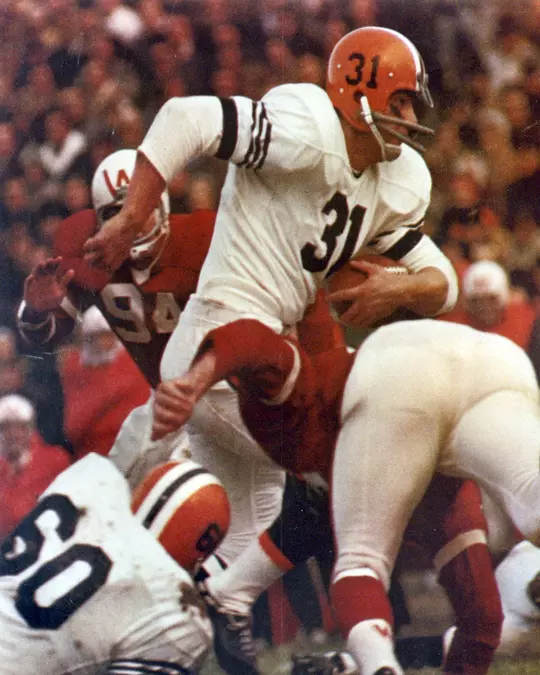
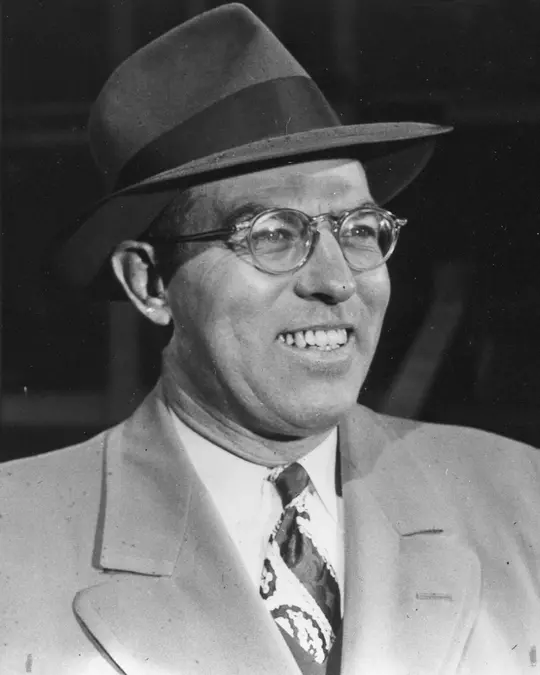
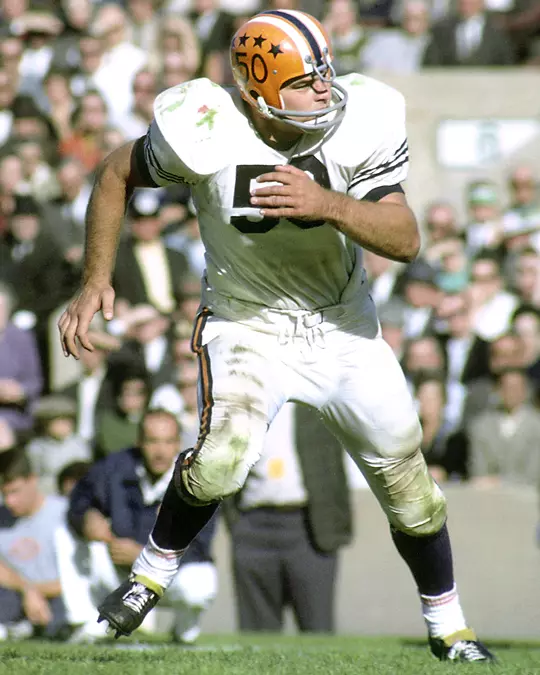
Elliott’s term as the Illini coach began with a 5-4 overall record in 1960, but he managed only two victories over the next pair of seasons. Despite a storm of criticism, Elliott’s recruiting efforts finally paid dividends in 1963. A talented sophomore class, featuring a backfield of Jim Grabowski and Sam Price, and a junior group that starred Dick Butkus allowed the Illini to rise rapidly in the national rankings.
The ’63 campaign began impressively with victories over good clubs from California and Northwestern. A 20-20 tie at Ohio State in game three impressed voters so much that Illinois rose to No. 7 in the national poll. The vastly improved Illini slipped in game seven, losing 14-8 to Michigan, but their confidence helped them rally.
The regular-season finale, scheduled for Saturday, Nov. 23, pitted Illinois against host Michigan State for the Big Ten title and a Rose Bowl berth. However, President John F. Kennedy’s assassination the Friday before in Dallas postponed the match-up until Thanksgiving Day. A superb Illini defense, led by Butkus, successfully derailed the Spartans, 13-0, and Illinois was Rose Bowl bound. The Orange and Blue’s 17-7 victory over Washington allowed them to finish third in the national rankings.
Elliott’s identical 6-4 records in 1964 and ’65 had set him up to ascend to Illinois’ athletic directorship in December, but those plans were ruined by tumultuous news of an illegal slush fund. Little more than one month later, the Big Ten demanded that Illinois fire Elliott and basketball coach Harry Combes for their improprieties.
New athletic director Gene Vance hired former Illinois star Jim Valek in March of 1967, but sub-par recruiting efforts ended the short-lived Valek regime at the end of the 1970 season.
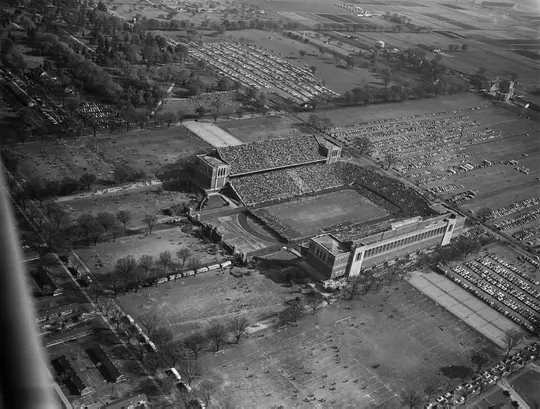
Memorial Stadium Scores - 1950-1969
| Date | (Ill. Rank) Opponent (Opp. Rank) | Score | W/L | Attendance |
| Sept. 30, 1950 | Ohio | 28-2 | W | n/a |
| Oct. 7, 1950 | (15) Wisconsin | 6-7 | L | 54,230 |
| Oct. 21, 1950 | Washington (10) | 20-13 | W | 35,930 |
| Oct. 28, 1950 | (12) Indiana (19) | 20-0 | W | 65,021 |
| Nov. 18, 1950 | (8) Ohio State (1) | 14-7 | W | 71,119 |
| Sept. 29, 1951 | UCLA | 27-13 | W | 53,265 |
| Oct. 6, 1951 | (8) Wisconsin | 14-10 | W | 56,207 |
| Oct. 13, 1951 | (7) Syracuse | 41-20 | W | 30,000 |
| Nov. 3, 1951 | (3) Michigan (15) | 7-0 | W | 71,119 |
| Nov. 10, 1951 | (2) Iowa | 40-13 | W | 56,444 |
| Sept. 27, 1952 | Iowa State | 33-7 | W | 47,338 |
| Oct. 11, 1952 | (13) Washington | 48-14 | W | 48,248 |
| Oct. 25, 1952 | Purdue | 12-40 | L | 71,119 |
| Nov. 15, 1952 | Ohio State | 7-27 | L | 60,077 |
| Nov. 22, 1952 | Northwestern | 26-28 | L | 41,214 |
| Sept. 26, 1953 | Nebraska | 21-21 | T | 40,011 |
| Oct. 3, 1953 | Stanford | 33-21 | W | 32,737 |
| Oct. 17, 1953 | (9) Minnesota | 27-7 | W | 55,641 |
| Oct. 24, 1953 | (7) Syracuse | 20-13 | W | 30,076 |
| Oct. 31, 1953 | (4) Purdue | 21-0 | W | 57,210 |
| Nov. 7, 1953 | (4) Michigan (17) | 19-3 | W | 71,119 |
| Sept. 25, 1954 | (6) Penn State | 12-14 | L | 54,094 |
| Oct. 9, 1954 | Ohio State (10) | 7-40 | L | 69,567 |
| Oct. 23, 1954 | Syracuse | 34-6 | W | 41,820 |
| Nov. 13, 1954 | Wisconsin (14) | 14-27 | L | 71,169 |
| Nov. 20, 1954 | Northwestern | 7-20 | L | 39,186 |
| Oct. 1, 1955 | Iowa State | 40-0 | W | 43,457 |
| Oct. 15, 1955 | Minnesota | 21-13 | W | 45,995 |
| Oct. 29, 1955 | Purdue | 0-13 | L | 61,262 |
| Nov. 5, 1955 | Michigan (3) | 25-6 | W | 58,968 |
| Sept. 29, 1956 | California | 32-20 | W | 54,833 |
| Oct. 13, 1956 | Ohio State (5) | 6-26 | L | 58,247 |
| Oct. 27, 1956 | Michigan State (1) | 20-13 | W | 71,119 |
| Nov. 17, 1956 | Wisconsin | 13-13 | T | 52,858 |
| Oct. 5, 1957 | Colgate | 40-0 | W | 41,594 |
| Oct. 19, 1957 | Minnesota (4) | 34-13 | W | 69,619 |
| Nov. 2, 1957 | Purdue | 6-21 | L | 47,690 |
| Nov. 9, 1957 | Michigan (11) | 20-19 | W | 46,007 |
| Nov. 23, 1957 | Northwestern | 27-0 | W | 27,017 |
| Sept. 27, 1958 | UCLA | 14-18 | L | 46,577 |
| Oct. 11, 1958 | Ohio State (5) | 13-19 | L | 50,416 |
| Oct. 25, 1958 | Michigan State (20) | 16-0 | W | 68,811 |
| Nov. 15, 1958 | Wisconsin (5) | 12-31 | L | 45,937 |
| Nov. 22, 1958 | Northwestern (20) | 27-20 | W | 32,390 |
| Oct. 3, 1959 | Army (4) | 20-14 | W | 64,891 |
| Oct. 17, 1959 | (13) Minnesota | 14-6 | W | 57,485 |
| Oct. 31, 1959 | Purdue (11) | 7-7 | T | 42,553 |
| Nov. 7, 1959 | Michigan | 15-20 | L | 45,573 |
| Nov. 21, 1959 | Northwestern (8) | 28-0 | W | 65,697 |
| Sept. 24, 1960 | (4) Indiana | 17-6 | W | 38,444 |
| Oct. 1, 1960 | (4) West Virginia | 33-0 | W | 43,612 |
| Oct. 8, 1960 | (4) Ohio State (5) | 7-34 | L | 71,119 |
| Oct. 22, 1960 | Penn State | 10-8 | W | 51,459 |
| Nov. 12, 1960 | Wisconsin | 35-14 | W | 43,165 |
| Sept. 30, 1961 | Washington | 7-20 | L | 41,319 |
| Oct. 7, 1961 | Northwestern | 7-28 | L | 40,138 |
| Oct. 21, 1961 | Minnesota | 0-33 | L | 52,247 |
| Nov. 4, 1961 | Purdue | 9-23 | L | 35,077 |
| Nov. 11, 1961 | Michigan | 6-38 | L | 40,179 |
| Oct. 13, 1962 | Ohio State (10) | 15-51 | L | 56,017 |
| Oct. 27, 1962 | USC | 16-28 | L | 31,375 |
| Nov. 17, 1962 | Wisconsin (4) | 6-35 | L | 36,762 |
| Nov. 24, 1962 | Michigan State | 7-6 | W | 19,547 |
| Sept. 28, 1963 | California | 10-0 | W | 42,357 |
| Oct. 5, 1963 | Northwestern (4) | 10-9 | W | 51,286 |
| Oct. 19, 1963 | (7) Minnesota | 16-6 | W | 61,229 |
| Nov. 2, 1963 | (2) Purdue | 41-21 | W | 61,796 |
| Nov. 9, 1963 | (2) Michigan | 8-14 | L | 55,810 |
| Oct. 10, 1964 | (2) Ohio State (4) | 0-26 | L | 71,227 |
| Oct. 24, 1964 | UCLA | 26-7 | W | 68,727 |
| Nov. 14, 1964 | Wisconsin | 29-0 | W | 55,077 |
| Nov. 21, 1964 | Michigan State | 16-0 | W | 32,000 |
| Sept. 18, 1965 | Oregon State | 10-12 | L | 34,000 |
| Sept. 25, 1965 | SMU | 42-0 | W | 45,175 |
| Oct. 16, 1965 | Indiana | 34-13 | W | 61,257 |
| Oct. 23, 1965 | Duke | 28-14 | W | 47,077 |
| Oct. 30, 1965 | Purdue (6) | 21-0 | W | 59,507 |
| Nov. 6, 1965 | Michigan | 3-23 | L | 50,136 |
| Sept. 24, 1966 | Missouri | 14-21 | L | 55,378 |
| Oct. 1, 1966 | Michigan State (1) | 10-26 | L | 57,747 |
| Oct. 8, 1966 | Ohio State | 10-9 | W | 51,069 |
| Oct. 22, 1966 | Stanford | 3-6 | L | 56,561 |
| Nov. 12, 1966 | Wisconsin | 49-14 | W | 53,645 |
| Sept. 30, 1967 | Pittsburgh | 34-6 | W | 51,251 |
| Oct. 7, 1967 | Indiana | 7-20 | L | 53,550 |
| Oct. 14, 1967 | Minnesota | 7-10 | L | 56,103 |
| Oct. 21, 1967 | Notre Dame | 7-47 | L | 71,227 |
| Nov. 4, 1967 | Purdue (6) | 9-42 | L | 61,262 |
| Nov. 11, 1967 | Michigan | 14-21 | L | 44,236 |
| Sept. 21, 1968 | Kansas | 7-47 | L | 46,359 |
| Sept. 28, 1968 | Missouri | 0-44 | L | 48,127 |
| Oct. 26, 1968 | Ohio State (2) | 24-31 | L | 56,174 |
| Nov. 16, 1968 | Northwestern | 14-0 | W | 42,099 |
| Nov. 23, 1968 | Iowa | 13-37 | L | 35,055 |
| Sept. 20, 1969 | Washington State | 18-19 | L | 40,345 |
| Oct. 4, 1969 | Iowa State | 20-48 | L | 37,663 |
| Oct. 11, 1969 | Northwestern | 6-10 | L | 43,928 |
| Nov. 1, 1969 | Purdue | 22-49 | L | 51,299 |
| Nov. 8, 1969 | Michigan (18) | 0-57 | L | 35,270 |
| Nov. 22, 1969 | Iowa | 0-40 | L | 30,257 |